REVIEW · SEVILLE
Seville: Medieval Walking Tour
Book on GetYourGuide →Operated by Andalusia Tour Travel · Bookable on GetYourGuide
Medieval Seville is a walk you can feel in your feet. This compact tour threads together legends, Jewish quarter lanes, and two of the city’s biggest landmarks in just about 75 minutes, with a live Spanish guide bringing it all together.
I especially like the focus on the older streets around Barrio Santa Cruz, including narrow lanes like La Calle del Beso and the romantic squares you reach a few turns at a time. I also like that the route connects the story of Seville (Hercules, Roman Hispalis, Arabic Isbiliya, and the city’s later global role) to what you see right in front of you.
One drawback to plan around: you’ll see major monuments, but entrance tickets are not included, so your exact time inside will depend on what you choose to buy.
In This Review
- Key Things To Know Before You Go
- Why a Medieval Walking Tour Fits Seville So Well
- Meeting at Plaza del Triunfo: Getting Your Bearings Fast
- Town Hall to Cathedral Area: The City Starts Talking
- Entering the Santa Cruz Quarter: Lanes, Legends, and Life
- La Calle del Beso and the Romantic Squares Moment
- Jewish Neighborhoods: Old and New, Told in Human Scale
- Gothic Cathedral Viewing: What You Notice When Someone Points
- Real Alcázar of the Moors: Power in Stone and Detail
- The Route in 75 Minutes: How to Make the Most of Short Time
- Price and Value: Is $47 Fair for What You Get?
- Who This Tour Suits Best (and Who Might Prefer Something Else)
- One Last Risk Check: Weather, Scheduling, and Real Life
- Should You Book This Seville Medieval Walking Tour?
- FAQ
- How long is the Seville medieval walking tour?
- How much does the tour cost?
- Where do I meet the guide?
- What major sights will I see on the tour?
- Are entrance tickets included?
- What language is the tour guide?
- Is the tour wheelchair accessible?
Key Things To Know Before You Go
- Plaza del Triunfo is your meet-up point, right by the Cathedral area
- Santa Cruz and the Jewish neighborhoods are the core vibe of the walk
- Expect big stops like the Gothic Cathedral and Real Alcázar
- The guide helps you skip the ticket line, but you still need your tickets
- You’ll be on your feet for about 75 minutes, so wear real shoes
Why a Medieval Walking Tour Fits Seville So Well
Seville is one of those cities where the past isn’t trapped behind glass. It shows up in street width, the turns you have to make, and the way courtyards and plazas are arranged. This tour leans into that. You’re not just looking at monuments—you’re moving through the historic fabric that made them matter.
I like that the tour gives you a story-thread instead of random facts. It connects myth and eras—Seville linked to Hercules, then Roman-era Hispal is, then Arabic-era Isbiliya—with the city’s later international prominence through the 1929 Ibero-American Exposition and the 1992 Universal Exposition. That makes the whole place feel less like a postcard and more like a living timeline.
The route also stays practical. In about 75 minutes, you’ll cover the medieval neighborhoods and still have a chance to orient yourself for the rest of your day—without burning half a day just getting oriented.
You can also read our reviews of more walking tours in Seville



Meeting at Plaza del Triunfo: Getting Your Bearings Fast
You meet your guide at the foot of the Monument to the Immaculate next to the Cathedral, at Plaza del Triunfo. That location is useful for two reasons.
First, it’s close to the main monument area, so you’re not spending time commuting across town before the story begins. Second, it helps you visually place the Cathedral right away—because you’ll keep returning your eyes to it as you walk through the nearby streets.
From there, the walk follows the heart of the historic center, including the area around Plaza Nueva (notably the Town Hall gate area). This matters because many first-time visitors start Seville in the wrong place—either too far from the old lanes or too far from the landmarks that anchor your mental map.
Town Hall to Cathedral Area: The City Starts Talking
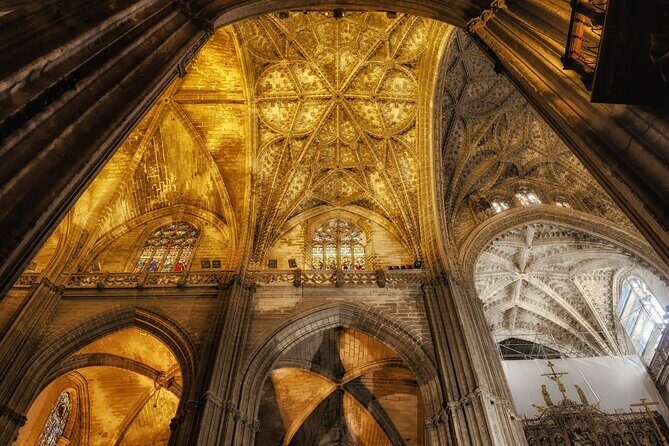
After you start, you head into streets around the Cathedral and Real Alcázar. Even if you don’t go inside immediately, just seeing the buildings from the right angles helps. You get a sense of scale fast, especially with the Gothic Cathedral, described here as one of the largest cathedrals in the world.
This is also where the guide’s approach really matters. The best walking guides don’t just point and name. They connect what you see to why it’s shaped the way it is—how a city’s power shows up in its architecture, and how religious and political influence overlap over centuries.
Practical note: the operator is not responsible for delays at monument entrances. Translation: if you plan to enter buildings after the walking portion, keep your expectations flexible and give yourself a buffer.
Entering the Santa Cruz Quarter: Lanes, Legends, and Life
Barrio Santa Cruz is the emotional center of this tour. This is where Seville often feels most medieval—tight streets, sudden views into small plazas, and corners that look like they’re built for slow wandering.
The tour doesn’t treat Santa Cruz like a museum exhibit. It frames it as a neighborhood with layers, including the old and new sides of the Jewish community. That matters because Seville’s Jewish story isn’t just one time period; it’s a sequence of presence, changes, and memory.
You’ll also get the kind of guidance that helps you understand the layout. Narrow streets can feel chaotic if you’re on your own. With a guide, those turns become part of a mental route: you start to anticipate what kind of space you’ll reach next—street, then small open area, then another tucked-in lane.
The only consideration here is physical: you’ll be walking on uneven or narrow streets at a steady pace. Comfortable shoes are not optional.
La Calle del Beso and the Romantic Squares Moment
One of the best parts of the route is the chance to walk down La Calle del Beso (the street name alone makes you slow down). This lane is a perfect example of how Seville turns legend into street-level atmosphere.
The tour also includes time for the quieter reward: romantic squares reached after those narrow lanes. These spaces are where photos look better than you expect, but more importantly where you can catch your breath and reset your bearings.
If you like travel where you can mix story and atmosphere, this portion is exactly that. If you’re the type who wants only “big-ticket” sights and timed-ticket entry, you may find these slower turns less satisfying. Still, even then, it’s hard to argue with Seville’s ability to make simple street geometry feel theatrical.






Jewish Neighborhoods: Old and New, Told in Human Scale
This tour specifically aims at both the ancient and the newer Jewish neighborhood areas. That gives you a broader sense of how the city treats memory—what remains visible, what is reshaped, and what’s carried forward through stories and place names.
Why I think this is a strong value: many short walking tours either focus on monuments only or focus on one neighborhood without context. Here, the Jewish quarter theme is paired with the city’s larger historical arc, so you’re not left with disconnected impressions.
You’ll come away with a clearer sense of why Santa Cruz isn’t just pretty streets. It’s a place people have tried to interpret through the centuries, and the city’s architecture and layout reflect that long attention.
Gothic Cathedral Viewing: What You Notice When Someone Points
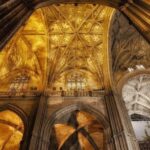
You’ll see the Gothic Cathedral as one of the anchor sights. The big win here isn’t pretending you’ll take in every detail from a sidewalk. It’s learning what to look for so that when you later pass the building on your own, you notice more than “giant church.”
Because the tour doesn’t include entrance tickets, you’ll likely experience the Cathedral in a guided exterior-and-nearby way during the walk. If you want the interior, plan on buying tickets separately. The upside: the tour is designed to skip the ticket line, so you can reduce friction when you decide to go in.
One caution: the operator can’t control monument entrance delays, so don’t stack your entire afternoon with tight timing after this tour.
Real Alcázar of the Moors: Power in Stone and Detail
The Real Alcázar of the Moors is the other major pillar of what you’re set to see. Even if you don’t enter during the walking portion, the presence of the Alcázar is hard to miss. It’s the kind of place that makes you understand why cities compete through architecture—power isn’t subtle here.
This is where a guide’s explanation really helps. Without context, you might read it as only “beautiful buildings.” With context, you start to see how artistic influence, rule, and identity show up in design choices—and how those choices reflect the era Seville rose and adapted through.
Since entrance tickets are not included, you’ll want to decide ahead of time whether you want to spend extra time inside after the tour. If you do, wear a watchful eye to your energy levels: you’ll have already walked through narrow historic lanes before you ever reach the stop where you might want to slow down.
The Route in 75 Minutes: How to Make the Most of Short Time
This is a 75-minute tour, which is ideal if you want medieval flavor without losing an entire morning. You’re moving through multiple themes quickly: legend and timeline, Jewish quarter streets, then major monuments that give the city its scale.
Here’s how to get the most out of a short format:
- Keep your camera ready, but don’t forget to look up and around at the street level too.
- Use the guide time to ask the big question: what does this street or building symbolize in Seville’s story?
- If you plan to enter the Cathedral or Real Alcázar, decide soon after the walk—so you don’t lose your momentum.
The main consideration is that the tour is time-boxed. You won’t have hours to wander independently between stops. Treat it like a guided “best of the medieval map” so you can then choose where to go next on your own.
Price and Value: Is $47 Fair for What You Get?
At $47 per person, this tour isn’t a budget throwaway—but it also isn’t the price of an all-day ticketed museum marathon. For the money, you get a live guide plus fees and taxes, and the route centers on high-impact areas: Santa Cruz and the major monument zone around the Cathedral and the Alcázar.
The value hinges on two choices:
1) If you want context, this kind of route is worth it because it transforms wandering into understanding.
2) If you’re paying more but skipping entrance tickets, you need to be okay with a guided viewing experience rather than full inside visits during the walk.
The skip-the-ticket-line feature is important too. It suggests the tour is built to reduce friction for major sights—so if you plan to go in after, this can help your overall flow.
If you only want one monument and you’re skipping the rest, there are cheaper options in Seville. But if you want a guided introduction to how medieval Seville hangs together, $47 for 75 minutes is a reasonable deal.
Who This Tour Suits Best (and Who Might Prefer Something Else)
This works especially well if you:
- want a quick but structured intro to Seville’s medieval core
- enjoy neighborhoods as much as major monuments
- like walking routes that include stories, not just photo stops
- prefer having a guide in Spanish, with a chance the tour could be conducted in two languages on some occasions
It might be less ideal if you:
- only care about interior visits and don’t want to mix street-level walking with monument viewing
- need lots of long stops to read or rest frequently (the route is short and designed to move)
It is wheelchair accessible, which is a major plus if you need an itinerary that doesn’t rely entirely on narrow, inaccessible paths.
One Last Risk Check: Weather, Scheduling, and Real Life
Most tours in a historic center are at the mercy of the same things you are: crowding, access changes, and timing at monument entrances. Here, the operator notes they’re not responsible for entrance delays, and if force majeure or special circumstances prevent visiting any sites, the guide will choose a similar location.
There’s also a practical warning worth taking seriously: one booking experienced a cancellation about an hour before the scheduled start. That’s not something you can eliminate, but you can reduce stress by keeping your afternoon flexible and having a backup plan for monument time.
Should You Book This Seville Medieval Walking Tour?
I’d book it if you want a guided shortcut into Seville’s medieval neighborhoods, especially Santa Cruz, and you want the Cathedral + Real Alcázar areas stitched into a story you can remember. The time is short, the focus is coherent, and the street-level design of Seville makes a walking format the right choice.
Hold off if your main goal is long interior time inside the monuments. Because entrance tickets aren’t included, you may end up adding on extra stops that this 75-minute structure can’t fully support.
If you’re doing Seville for the first time and you want to understand what you’re seeing without spending hours piecing it together yourself, this is a smart, efficient way to start.
FAQ
How long is the Seville medieval walking tour?
The tour lasts about 75 minutes.
How much does the tour cost?
The price is $47 per person.
Where do I meet the guide?
Meet your guide at the foot of the Monument to the Immaculate next to the Cathedral at Plaza del Triunfo, Seville.
What major sights will I see on the tour?
You’ll walk through the Santa Cruz Quarter and see the Cathedral area and the Real Alcázar of the Moors.
Are entrance tickets included?
No. Entrance tickets are not included.
What language is the tour guide?
The tour guide is Spanish. On some occasions, the tour could be conducted in two languages.
Is the tour wheelchair accessible?
Yes, the tour is wheelchair accessible.