REVIEW · SEVILLE
Excursion to Italica from Seville
Book on Viator →Operated by Sevilla Moving · Bookable on Viator
Roman ruins and a monastery, in one easy day. I love the Itálica guided walk through standout mosaics and Roman homes, and I also like the jump to the medieval San Isidoro del Campo monastery right after. The main thing to consider is pacing: you’ll be on your feet for most of the 5-hour outing.
This trip runs about 5 hours total, starting at 9:00 a.m. in Seville, then heading to Santiponce (a quick drive). The first stop is around 3 hours at Itálica, and the second stop is about 2 hours at the monastery, with admission tickets included at both sites.
I also appreciate the small group size (up to 8) and the English-speaking guide-driver. In reviews, guides such as Miguel are praised for answering questions clearly and keeping the visit friendly, which makes a big difference when you’re trying to connect the ruins to real Roman life.
In This Review
- Key things to know before you go
- Why Itálica feels more real than most “Roman ruins”
- Walking Itálica’s Roman streets: mosaics, thermal baths, and houses
- The amphitheater and the Roman theatre: the “wow” factor comes fast
- San Isidoro del Campo monastery: the shift from Rome to medieval Spain
- Price and logistics: what $83.08 covers and why it’s usually fair
- How to get the most out of both stops
- Who should book this Italica and San Isidoro tour
- Should you book this tour?
- FAQ
- Is admission included for both stops?
- What language is the tour offered in?
- How long is the excursion from Seville?
- Where does the tour start, and what time does it begin?
- Is the group small?
- Can I cancel for a full refund?
Key things to know before you go
- Small group feel (max 8 people): easier questions, less waiting around.
- Two very different worlds in one day: Roman street life, then a medieval fortress monastery.
- Admission tickets are included: you’re not doing the add-on math at the gates.
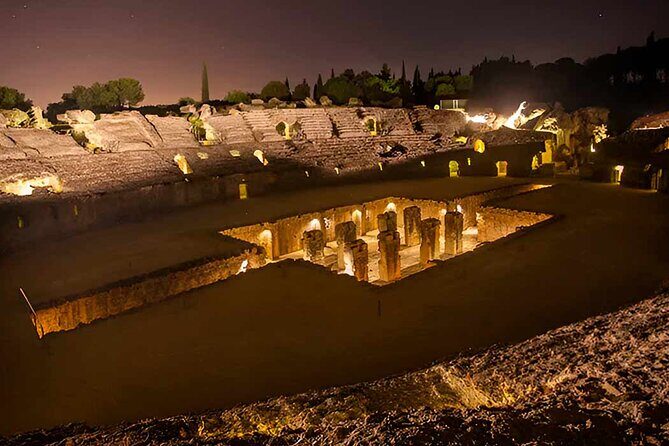
- Itálica’s scale is real: amphitheater capacity of about 25,000 and a major Roman theater.
- Air-conditioned transport included: helpful on warmer days, even if the walking takes most of the time.
Why Itálica feels more real than most “Roman ruins”
Itálica is a Roman city tied to major names, not just generic ruins. It’s known for emperors like Hadrian and Trajan being born there, which adds weight when you’re standing in the same areas where elite Roman families once lived and ruled.
What makes the site especially worth your time is how varied it feels. You’re not just looking at one monument; you’re moving through ancient streets and neighborhoods. That turns the day from a sightseeing checklist into a story you can actually follow—how people lived, relaxed, and gathered.
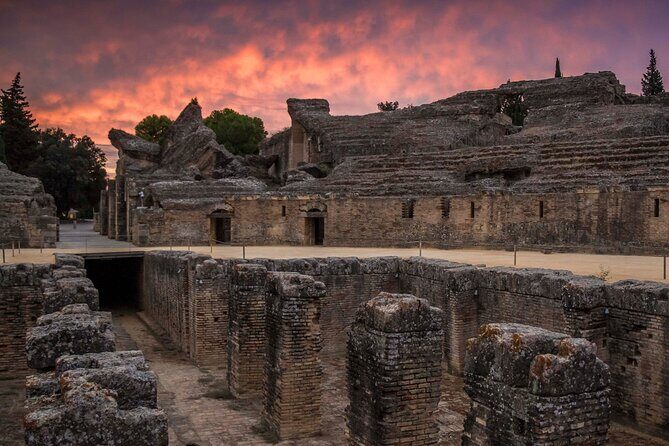
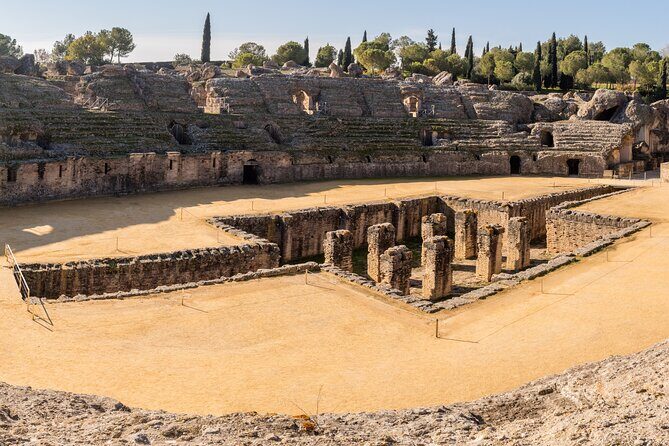
One practical note: Itálica is the third largest amphitheater in the world and holds about 25,000 spectators. Even if you’ve toured other Roman sites, that kind of scale tends to reset your expectations fast, because you start thinking in crowds, not just architecture.
You can also read our reviews of more tours and experiences in Seville.


Walking Itálica’s Roman streets: mosaics, thermal baths, and houses
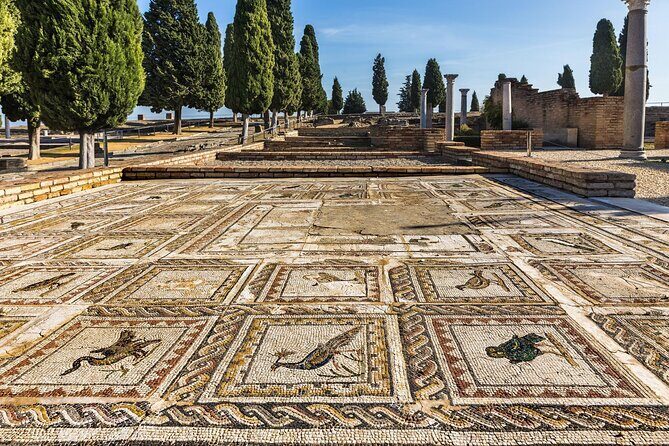
The tour starts in Seville around 9:30 a.m. and you’ll reach Santiponce quickly—just over 15 minutes on the road. Then you’re guided into Itálica, where the goal is to help you “read” the place instead of just pass through it.
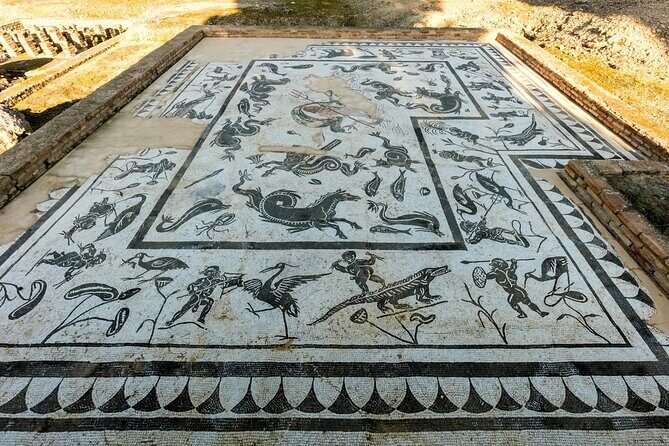
Expect to see preserved highlights like mosaics, thermal baths, and residential areas. Mosaics are often what people remember most, but I like that this stop doesn’t treat them as decoration. With a good guide, you start noticing what the mosaics suggest about wealth, daily routines, and the kinds of rooms people actually used.
Two house areas are called out during the visit: the area connected to Neptune and the House of the Birds (you’ll see how their names connect to what’s preserved). Even without technical jargon, these labels make it easier to picture what you’re looking at, especially if you’re not a dedicated archaeology person.
This is also where the best guides win you over. In the feedback for this excursion, Miguel gets mentioned for extensive site knowledge and for adding context that makes the ruins feel logical. You’ll get more from the visit when you ask questions—so if something confuses you (like how a space changed over time), this is a good moment to raise it.
The amphitheater and the Roman theatre: the “wow” factor comes fast
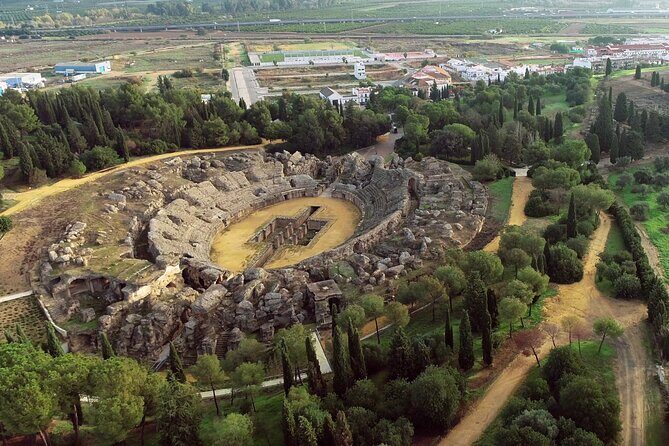
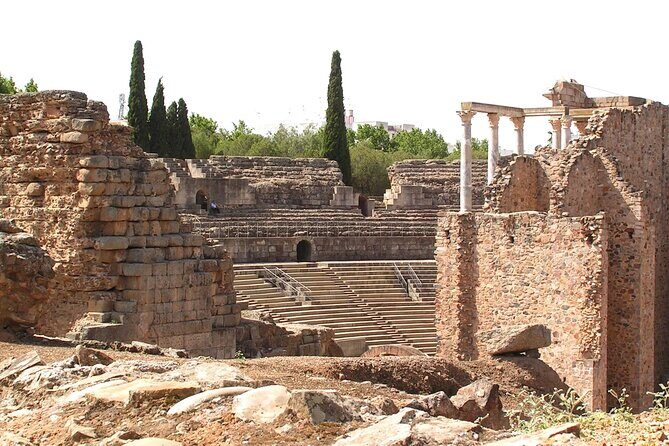
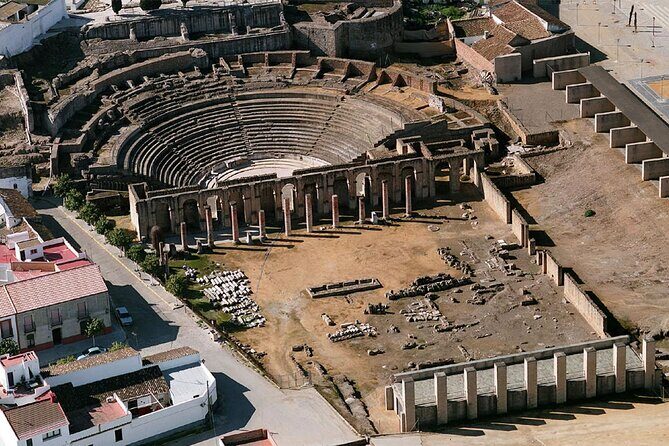
After time walking through the city’s everyday spaces, you get to the big set pieces. The Itálica Amphitheater is famous for gladiator fights, and the guide will connect what you see to how crowds used this space.
Because it’s about 25,000 seats, your brain naturally shifts into “event mode.” You start imagining where spectators entered, where performers stood, and how sound and sight worked. That’s exactly why amphitheaters usually land so well during a guided tour: the scale makes the explanation stick.
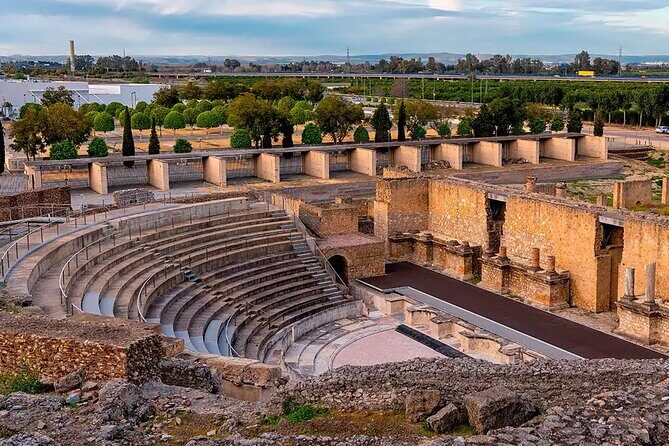
You’ll also see the Roman Theatre, which was discovered in the middle of the 20th century. That detail matters more than it sounds. When a major structure is uncovered only in modern times, you get a reminder that archaeology is still actively shaping what we think we know—and that the ruins you’re seeing are part of an ongoing recovery.
If you’re the type who enjoys history but gets impatient with slow pacing, you may like this itinerary’s structure. The first part builds comprehension (streets, homes, baths). The second part gives you emotional payoff (amphitheater, theater).
San Isidoro del Campo monastery: the shift from Rome to medieval Spain
Once you wrap up Itálica (about 3 hours), you’ll move to the second stop: the Monastery of San Isidoro del Campo. This is where the day stops being Roman and becomes medieval—no gradual transition, just a clear change of gear.
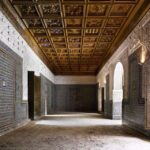
This monastery is described as a medieval fortress that holds treasures across multiple styles and periods, including Mudejar, Gothic, and Baroque. That mix is useful for you because it keeps the visit from feeling one-note. You’re looking at a site that changed over time, which is exactly how real buildings behave in Spain.
The tour calls out paintings, murals, and significant sculptures. In my experience, these are the elements that reward your attention if you’re willing to slow down for a few minutes. Murals and wall art can be easy to miss when you’re rushing, but in a guided format you tend to get pointed to the details that make the monastery feel alive rather than frozen.
The monastery visit runs about 2 hours, and after that you head back to Seville, where the guide says goodbye at the end. This timing works well because you’re not stuck in a long second segment. You’re leaving while the day still feels energetic, not stretched thin.
Price and logistics: what $83.08 covers and why it’s usually fair
The price is $83.08 per person, and the big value point is what’s included. You get air-conditioned transport, private transportation, and a guide-driver, plus admission tickets for both Itálica and San Isidoro del Campo.
It also helps that this is a small group (maximum 8). When tours pack in more people, the guide’s attention gets diluted and you spend more time waiting. Here, the format is set up so you can ask questions and actually hear the answers without craning your neck.
Food and drinks are not included, so you should plan a light strategy. If you normally get hungry on tours, consider eating something before you depart, or plan a meal back in Seville after you return. You’ll likely want water too, because you’re touring outdoors for part of the day.
One more practical detail: you’ll use a mobile ticket, and the experience is offered in English. The meeting point is Sevilla Moving at C. Luis Montoto, 19 (Local Bajo), and the start time is 9:00 a.m. Since the return is back at the meeting point, it’s easier to plug this into a simple day plan without complex transfers.



How to get the most out of both stops
This itinerary works best when you treat it like two short lessons instead of one long walk. At Itálica, focus on connecting what you see—mosaics, baths, houses—to what Roman daily life likely looked like. At the monastery, switch gears and pay attention to how different art styles show up in one place.
Here are a few practical ways to make it easier:
- Bring comfortable shoes. You’ll be walking through ancient spaces and museum-like areas.
- Have questions ready. Reviews highlight that the guide encourages Q&A and gives meaningful insights.
- Use the early timing. You start in the morning, so you’ll avoid the most intense part of the day for some walking.
- Plan your lunch. Food and drinks aren’t included, so decide where you’ll eat after you’re back in Seville.
And if you’re history-first, you’ll like the structure. The day starts by building context at Roman street level, then rises to the amphitheater and theatre. After that, it gives you a clean contrast with the monastery’s medieval layers.
Who should book this Italica and San Isidoro tour
This is a great fit for you if you:
- Want a guided Roman ruins experience that explains what you’re seeing.
- Prefer smaller groups where you can ask questions.
- Like contrasts: Roman city life, then a medieval fortress monastery with multiple art periods.
It also suits first-timers to Itálica who don’t want to piece together the site on their own. The guide-driver setup means you’re not worrying about timing between Santiponce and Seville while also trying to interpret archaeology.
If you hate walking, though, you might find the day demanding. The itinerary includes about 3 hours at the archaeological site plus 2 hours at the monastery, so you’ll want to be comfortable standing and moving for most of the tour.
Should you book this tour?
If you’re choosing between doing Itálica alone and doing it with context, I’d lean toward booking. The combination of guided interpretation, included admission tickets, and a small-group size makes the experience feel more complete than a quick self-guided pass.
You should also book if you want more than one “wow” moment. The amphitheater scale and Roman theatre are big-ticket sights, and the monastery stop adds a very different kind of historical atmosphere in the same day. Just go in knowing it’s a hands-on walking day, and you’ll be set.
FAQ
Is admission included for both stops?
Yes. Admission tickets are included for Itálica (about 3 hours) and for the Monastery of San Isidoro del Campo (about 2 hours).
What language is the tour offered in?
The excursion is offered in English.
How long is the excursion from Seville?
It runs for about 5 hours total, with the main split being roughly 3 hours at Itálica and 2 hours at the monastery.
Where does the tour start, and what time does it begin?
It starts at Sevilla Moving, C. Luis Montoto, 19, Local Bajo, 41003 Sevilla, Spain, at 9:00 a.m. The tour ends back at the meeting point.
Is the group small?
Yes. The experience has a maximum of 8 travelers.
Can I cancel for a full refund?
Yes. You can cancel up to 24 hours in advance of the start time for a full refund. If you cancel less than 24 hours before the start, the amount paid is not refunded.