REVIEW · SEVILLE
Electric Bike Tour in Seville
Book on Viator →Operated by Rent a Bike Sevilla · Bookable on Viator
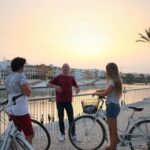
Two wheels, big sights, minimal sweat. This electric bike tour is a fast, friendly way to glide from Seville’s park beauty to major landmarks with battery-powered boost and a guide who ties it all together. I like how the pacing keeps you moving without feeling rushed, and I also like the hands-on feel of an e-bike when you’re hopping between neighborhoods. The one thing to consider: bikes can feel tall at first for shorter riders, so ask about sizing early if you’re traveling with kids.
You’ll spend about 2 hours 30 minutes to 3 hours in the saddle, starting in the old center at Plaza de Santa Cruz and riding toward some of Seville’s most famous architecture. The tour runs in all weather, so plan on bringing rain gear if the forecast looks iffy. For many people, that combo of speed + guidance is the sweet spot in a city where “getting around” can eat up the day.
In This Review
- Key Points You’ll Feel on This Ride
- Why an Electric Bike Tour Works in Seville’s Layout
- Where You Meet at Plaza de Santa Cruz (and What That Means for Your Day)
- Parque de María Luisa: Moorish-Style Gardens and a Botanical-Style Pause
- Watch-outs at Parque de María Luisa
- Plaza de España: A Landmark Built for an Exposition, Still Built for a Photo
- A practical thought about this stop
- Toward Torre del Oro: Reading Seville Along the Guadalquivir
- What to do on this stop
- Triana Bridge (Puente de Isabel II): A Fast Crossing With Serious History
- Tip for the ride moment
- The Giralda and Seville Cathedral: From Mosque Minaret to Gothic Giant
- The Giralda
- Seville Cathedral
- The practical reality
- The Royal Alcázar of Seville: Mudéjar Details That Change With Each Angle
- How to enjoy the Alcázar on a bike tour
- Price and Value: Why This E-Bike Tour Is Often a Smart First Step
- Booking timing
- Practical Tips for the E-Bike (So You Don’t Spend the Ride Fighting It)
- Should You Book This Electric Bike Tour in Seville?
- FAQ
- How long is the Electric Bike Tour in Seville?
- Where does the tour start and end?
- What’s included in the price?
- Is the tour in English and is it private?
- Do I need to bring food or drinks?
- Does the tour run in bad weather?
- Is there free admission for any stops?
Key Points You’ll Feel on This Ride
- Electric assist that helps you keep pace without turning every street into a workout
- A guide-led loop that connects parks and monuments into one story
- Parque de María Luisa time built in so you get more than a drive-by photo stop
- Big-name landmarks in one go including Torre del Oro, the Giralda, and the Royal Alcázar
- Private group setup where the tour can move at your group’s rhythm
Why an Electric Bike Tour Works in Seville’s Layout

Seville is beautiful, but it can be long-winded if you try to do everything on foot. An electric bike tour fixes that. You can cover historic streets and major sights without arriving at the next stop totally cooked.
What I like most about the e-bike approach is that it levels the playing field. People with different fitness levels can still enjoy the same route. Even if you’re comfortable walking, the motor support makes it easier to focus on what matters: looking up at facades, reading the guide’s landmark connections, and enjoying the parks instead of just getting from A to B.
There’s also a practical bonus: your time lines up better with the city’s schedule. This kind of 2.5- to 3-hour ride gives you a structured overview that helps you plan what to return to later.
You can also read our reviews of more cycling tours in Seville
Where You Meet at Plaza de Santa Cruz (and What That Means for Your Day)
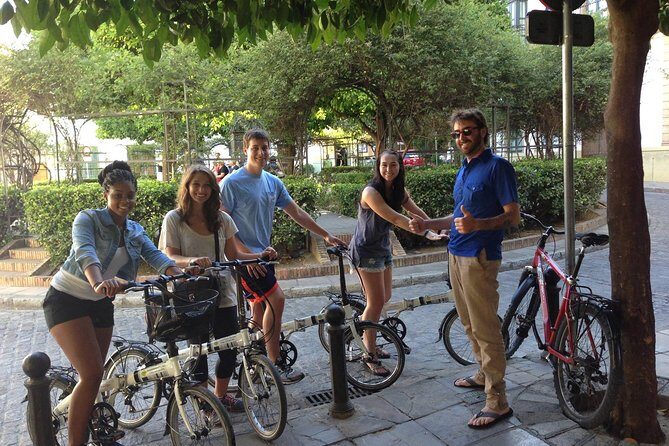
The meeting point is Plaza de Santa Cruz in the old center, and the tour ends back there. That matters more than it sounds. You’re starting where you can easily extend the day with wandering—dinner, a gelato stop, or a night stroll—without a separate transfer.
The tour is designed as a private experience for your group only, and it’s offered in English. You’ll also have a local guide, plus a helmet and bottled water included. Since it’s a mobile-ticket experience, you won’t need to hunt for paper tickets.
The biggest “feel” detail is the rhythm. You’re not doing museum marathons. You’re riding, stopping, looking, and listening in a way that fits a half-day mindset.
Parque de María Luisa: Moorish-Style Gardens and a Botanical-Style Pause
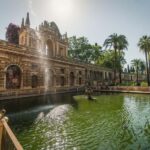
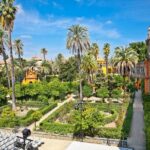
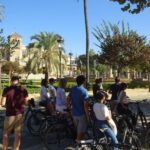
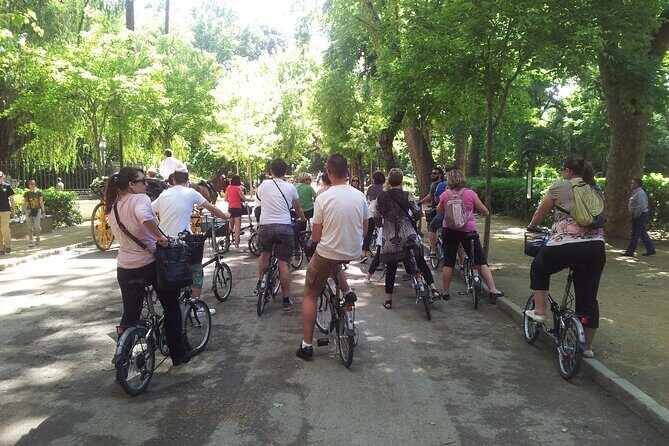
Your first major stop is Parque de María Luisa, a park with a layered origin that makes the setting more than just pretty scenery. Much of the park grounds used to be the gardens of the Palace of San Telmo. In 1893, the Duchess of Montpensier donated the grounds to the city for public use.
Then the park took on a second life with the 1929 Ibero-American Exposition. The architect Aníbal González began construction connected to that event, and the park’s center is now defined by a Moorish paradisical style: tiled fountains, pavilions, walls, ponds, benches, and exhedras.
One reason this stop lands is the sense of variety within greenery. You get palms, orange trees, Mediterranean pines, and stylized flower beds with shady spots formed by vines. It’s also described as a botanical garden, with native and exotic plants represented, plus educational panels.
And yes, there are plenty of birds. The park is known for its large population of doves, so don’t be surprised if you see them hanging around near paths where people pause.
Time note: you’ll spend about 30 minutes here, and the admission is listed as free. That makes it an easy win early in the tour when you still have energy and curiosity.
Watch-outs at Parque de María Luisa
Because this is a garden stop inside a park, you’ll want to keep an eye on how crowded paths can get during peak hours. Also, if you’re riding right after a stop, take a breath and re-check your footing before you roll onward.
Plaza de España: A Landmark Built for an Exposition, Still Built for a Photo
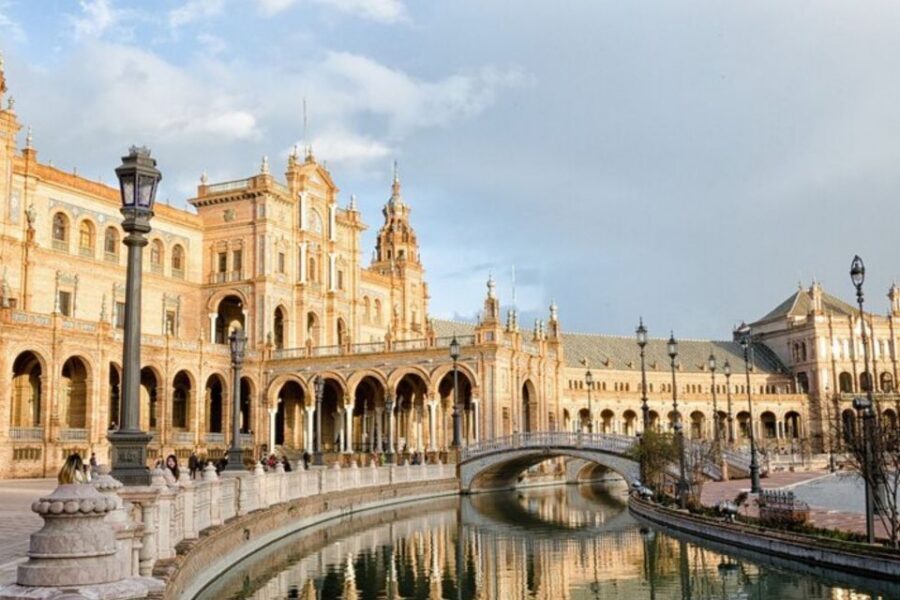
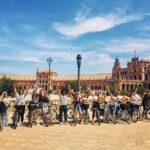
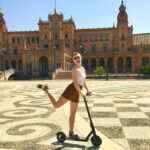
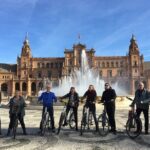
Next up is Plaza de España, also in Parque de María Luisa. This is one of those places where the guide’s words help you see what you’re looking at. The plaza was built in 1928 for the Ibero-American Exposition of 1929, so it’s tied to a specific moment in Seville’s modernization.
Architecturally, it’s a recognizable mix: Regionalism Architecture with elements of Baroque Revival, Renaissance Revival, and Moorish Revival (Neo-Mudéjar) styles. In other words, you get a visual blend of European styles and the strong Mudéjar-Moorish influence that runs through Seville’s identity.
Time note: the listed time is about 10 minutes, and the admission ticket is free. That short window is enough for context and first impressions, especially with a guide pointing out the style mix.
You can also read our reviews of more tours and experiences in Seville
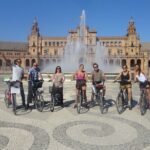
A practical thought about this stop
If you’ve seen Plaza de España in photos, it can still feel real in person only if you slow down for a moment. I’d use the guided explanation to orient your eyes before you start taking your own photos.
Toward Torre del Oro: Reading Seville Along the Guadalquivir
Then the route turns into something more cinematic: the river area. Your stop is Torre del Oro, a dodecagonal watchtower tied to Seville’s control of access via the Guadalquivir River.
The Torre del Oro was erected by the Almohad Caliphate in the early 13th century to manage who could enter Seville from the water. It’s a rare kind of landmark: part military infrastructure, part historical clue.
Here’s what makes it interesting beyond the name. It served as a prison during the Middle Ages, and its name comes from the golden shine it projected on the river. The color effect is linked to the materials used: mortar, lime, and pressed hay.
The tower’s shape also changes over time. It’s divided into three levels:
- The first dodecagonal level was built around 1220 by order of the Almohad governor of Seville, Abù l-Ulà.
- The second dodecagonal level was built in the 14th century by Peter of Castile, and archaeological studies confirm the hypothesis.
- The third, uppermost circular section was added after damage from the 1755 Lisbon earthquake, rebuilt by Brusselian Sebastian Van der Borcht in 1760.
This stop is where you start to feel the tour’s value: the guide turns stone into a timeline. On an e-bike, you can reach this kind of layered monument without losing half a day to transport.
What to do on this stop
Take a second to look at how the tower’s “military logic” fits the river setting. It helps your brain connect the past function to the modern view.
Triana Bridge (Puente de Isabel II): A Fast Crossing With Serious History
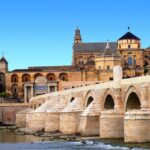
From Torre del Oro, the ride continues to the Puente de Isabel II, often called the Puente de Triana. This is a metal arch bridge connecting Triana with the city center.
What I like about this stop is how it explains geography as well as architecture. The bridge crosses the Canal de Alfonso XIII, one of the arms of the Guadalquivir that isolates Triana like an almost-island.
Historically, the bridge completed in 1852 replaced an earlier floating bridge made of boats—a pontoon bridge. The pontoon bridge managed to last for centuries through later repairs, and the text notes that Moors built a pontoon bridge back in the 12th century.
So even though the bridge is just a crossing in the middle of a tour, it carries an entire story about how Seville moved people and controlled access through shifting river channels.
Tip for the ride moment
Keep your eyes up while you cross. With an e-bike, you can take in water views and city skyline angles without stopping your day.
The Giralda and Seville Cathedral: From Mosque Minaret to Gothic Giant
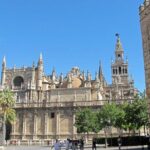
Next comes the skyline moment: the Giralda and Seville Cathedral. If you’ve ever wondered why Seville’s skyline looks Moorish even when you know it’s Spanish, the answer is right here.
The Giralda
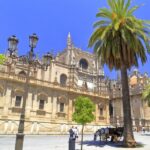
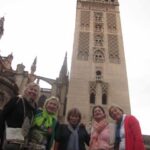
The Giralda is the bell tower of Seville Cathedral. It was originally built as the minaret for the Great Mosque of Seville during the Almohad dynasty. Later, the Catholics added the Renaissance-style top after the expulsion of Muslims from the area.
The tower dates from the Reconquest period starting 1248 through the 16th century, and it remains one of the city’s most important symbols. It’s also listed as a UNESCO World Heritage Site (along with the Alcázar and the General Archive of the Indies).
Height matters here: the Giralda is 104.1 meters tall.
Seville Cathedral
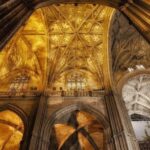
Seville Cathedral is a Roman Catholic cathedral registered as a UNESCO World Heritage Site in 1987, alongside the Alcázar complex and the General Archive of the Indies. It’s described as the fourth-largest church in the world and the largest Gothic church, occupying 11,520 square meters.
The guide also connects the cathedral to major moments in royal life and world history. For example:
- The cathedral was the site of the baptism of Infant Juan of Aragon in 1478.
- The royal chapel holds the remains of Ferdinand III of Castile, Alfonso the Wise, and their descendant king Peter the Just.
- Christopher Columbus and his son Diego are buried in the cathedral.
This is one reason I like getting these stops through a guided route. You can see the scale, but the added context gives the scale meaning.
The practical reality
Cathedrals ask for your attention, not just your phone. If you prefer to read and stare for a minute, build that into your schedule. An e-bike makes it possible; you’re not sacrificing your whole day to get there.
The Royal Alcázar of Seville: Mudéjar Details That Change With Each Angle
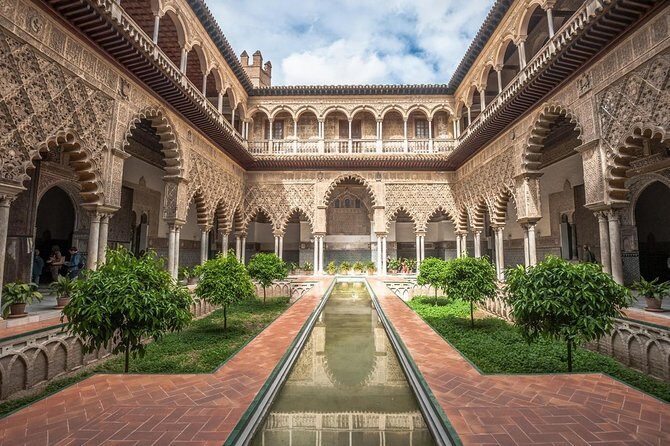
Your final major landmark is the Royal Alcázars of Seville (Reales Alcázares de Sevilla), commonly called the Alcázar.
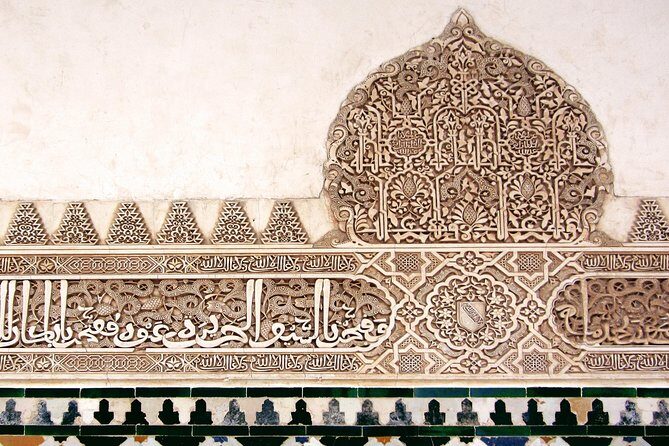
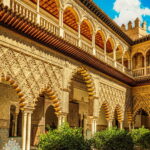
This palace is tied to power shifts across cultures. It was originally associated with an Abbadid Muslim alcazar on the site, destroyed after the Christian conquest. The palace you visit today was built for Peter of Castile, with Castilian Christians building on that earlier foundation.
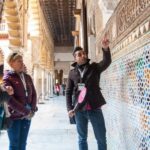
Architecturally, it’s a strong Mudéjar example in the Iberian Peninsula, while also featuring Gothic, Renaissance, and Romanesque design elements from different construction phases. If you like places that show layers rather than one single style, this is your stop.
One more detail that helps you understand why this place feels both grand and lived-in: the upper storeys are still occupied by the royal family when they’re in Seville. Administration is by Patrimonio Nacional.
Like the cathedral and Giralda, it’s part of a UNESCO World Heritage listing from 1987.
How to enjoy the Alcázar on a bike tour
You’re not wandering for hours. So focus on what the guide points out, then use your own eyes to check those details in place. The palace is the kind of building where small pattern differences matter, especially when you only have a limited time window.
Price and Value: Why This E-Bike Tour Is Often a Smart First Step
The price is $48.06 per person, with a duration of about 2 hours 30 minutes to 3 hours. That might sound like a lot at first, but here’s what you’re getting for the money: a local guide, helmet, the bicycle, and bottled water are included.
You’re also stacking multiple headline sights into one structured experience. On a normal day, you’d spend time and energy just moving between distant points: parks, river towers, bridges, cathedral scale, and the Alcázar. The e-bike does that hard work.
It’s also listed as having group discounts, and the experience is designed as a private tour for your group only. That can make a noticeable difference if you’re a family or small group and want a guide to slow down when someone needs a break.
One cost note: food and drinks are not included, and there’s no hotel pickup or drop-off. So if you’re budgeting, plan on buying snacks elsewhere or coming prepared.
Booking timing
On average, it’s booked about 26 days in advance. If your trip overlaps popular dates, I’d treat it like a “book it when you know your schedule” activity, not a last-minute option.
Practical Tips for the E-Bike (So You Don’t Spend the Ride Fighting It)
The electric assist is there to help, but you still need a comfortable start. Here are the practical points I’d follow.
First, ask for a quick bike operation demo before you set off. Knowing how the assist kicks in and how to start smoothly can reduce stress right away.
Second, don’t assume you’ll always need the motor. Seville can be flat in places, so the boost may feel optional on some stretches. Still, it’s valuable for longer rolling segments and for keeping a comfortable pace when you’re riding in a group.
Third, think about fit. Reviews (and real life) often come down to one issue: some bikes can feel big at first. If you’re short, or traveling with kids, confirm that the provider can match the right bike size before you show up at the meeting point.
Fourth, dress for the weather. The tour runs in all weather conditions, so bring what you’d bring for a city walk: a light layer, and rain protection if needed. Rain can actually make parks feel cooler and shadeier, but you’ll still want grip and coverage.
Finally, bring your attention. This is not a “bike fast and ignore the guide” kind of tour. The value is in the explanations that connect sites: why the tower exists, why the cathedral is built the way it is, why Mudéjar style appears where you expect Moorish influences.
Should You Book This Electric Bike Tour in Seville?
I think this is a strong choice if you want a guided overview that covers major sights without exhausting yourself. It’s especially good for first-timers, couples who don’t want to piece together multiple transport hops, and families who want something fun that still has real context.
Skip it, or at least approach carefully, if your group includes very short riders or children and you’re not confident you’ll get the right bike size. Also, if you’d rather spend your time deeply inside one monument rather than seeing several landmarks in one ride, you might prefer a more museum-focused day.
If you do want a fast, friendly way to connect Seville’s parks and iconic architecture, this e-bike format is built for exactly that.
FAQ
How long is the Electric Bike Tour in Seville?
The tour runs about 2 hours 30 minutes to 3 hours (approx.).
Where does the tour start and end?
It starts at Plaza de Santa Cruz (Pl. de Sta Cruz, Casco Antiguo, 41004 Sevilla, Spain) and ends back at the same meeting point.
What’s included in the price?
Included items are bottled water, a local guide, and use of the bicycle and helmet.
Is the tour in English and is it private?
Yes, the tour is offered in English, and it’s a private experience where only your group participates.
Do I need to bring food or drinks?
Food and drinks are not included, so you’ll want to plan for your own snacks or drinks.
Does the tour run in bad weather?
Yes. It operates in all weather conditions, and you should dress appropriately.
Is there free admission for any stops?
The information provided lists free admission ticket for Parque de María Luisa and for Plaza de España.