REVIEW · SEVILLE
Seville Bike Tour
Book on Viator →Operated by Sevilla Bike Tour · Bookable on Viator
Seville by bike is one of the fastest ways to get your bearings. This 3-hour ride threads together the city’s biggest landmarks with short, focused stops, so you’re not spending your day in long lines or wandering. I like that it’s built around major sights—Torre Giralda and Plaza de España alone would justify a bike tour.
I also like the practical setup: a small group (up to 15), English option, a mobile ticket, and simple extras like a water bottle and bicycle included. The one thing to consider is that entry is not included for several key monuments, so you may want to budget for tickets depending on which stops you plan to go into.
In This Review
- Key highlights you’ll feel right away
- Price and what you actually get in 3 hours
- Meeting point near Casco Antiguo: start smart, not stressed
- Torre Giralda: how the ramps shape the view
- Catedral de Sevilla: the mosque-to-cathedral story you can spot
- Real Alcázar de Sevilla: palace drama outside the screen
- Plaza de España and Maria Luisa Garden: the 1929 wow factor
- Torre del Oro: the river landmark with colonial ties
- Barrio Santa Cruz: patios, lanes, and an old Jewish quarter feel
- Real Fábrica de Tabacos: when industry becomes a landmark
- Río Guadalquivir: the biggest river that still lets boats run
- Triana across the water: flamenco, ceramics, and explorer lore
- Real Maestranza de Caballería: bullfighting arena and noble schooling roots
- How fit and weather should shape your day
- Is it worth $36.05? My take on value
- Should you book this Seville Bike Tour?
- FAQ
- How long is the Seville Bike Tour?
- How much does the tour cost?
- What language is the tour offered in?
- Where does the tour start?
- Do I need tickets for the monuments?
- What if weather is bad or I need to cancel?
Key highlights you’ll feel right away
- A tight 3-hour loop across top Seville sights with short stop times so you keep moving
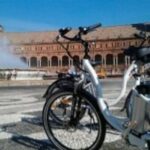
- Bike + water included for a low-stress, budget-friendly way to cover distance
- Iconic Moorish-Christian mix at the Giralda, Cathedral, and Alcázar
- Plaza de España + Parque de María Luisa bring shade, fountains, and serious wow-factor
- Guadalquivir and Triana give you a real sense of the city’s river life and culture
- Mostly exterior viewing with quick looks at monuments (and some stops list free entry)
Price and what you actually get in 3 hours
At $36.05 per person, this bike tour is priced like a “time-saver” more than a full-on ticket bundle. The big value is what’s included: bicycle use and a water bottle. That matters in Seville, where you’ll feel the distance fast if you’re walking between the Cathedral area, the Alcázar, Plaza de España, and the river neighborhoods.
You’re also getting a structured route. The itinerary is set up as a sequence of short stops—most are around 10 to 20 minutes—so you can see a lot without turning the day into a scavenger hunt. It’s also offered in English, and it caps at 15 travelers, which tends to keep the pace manageable.
One more practical note: the tour is described as tour only from the outside. That doesn’t mean you see nothing at all—it means you’re mostly doing ride-by viewing and quick stop moments rather than a deep, timed ticket tour of every interior room. Some stops list admission as free, while others say tickets aren’t included, so it’s smart to plan which sights you’ll want to enter if you can.
You can also read our reviews of more cycling tours in Seville
Meeting point near Casco Antiguo: start smart, not stressed
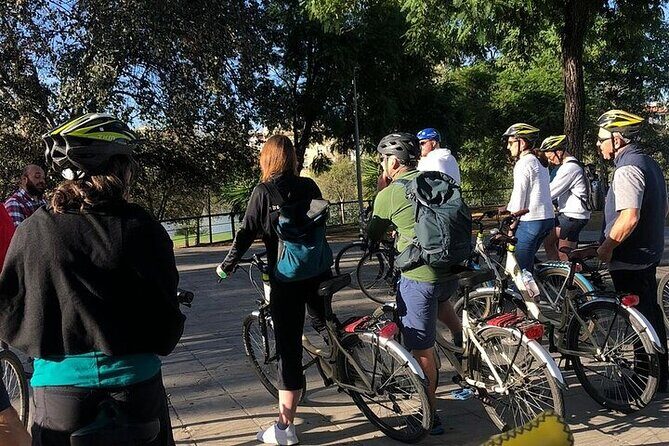
The tour starts at C. Arjona, 8, Casco Antiguo, 41001 Sevilla and ends back at the same meeting point. This location is handy because it puts you near the historic core from the jump. If you’re already staying around old Seville, you’ll likely waste less time getting there.
Because it’s a mobile ticket experience, you’ll want your phone battery topped up. Also, since it’s “confirmation will be received at time of booking,” make sure you have that confirmation ready before you show up.
Finally, it’s listed as near public transportation, so if you’re not starting from your lodging on foot, you can still reach the meeting point without a long detour.
Torre Giralda: how the ramps shape the view
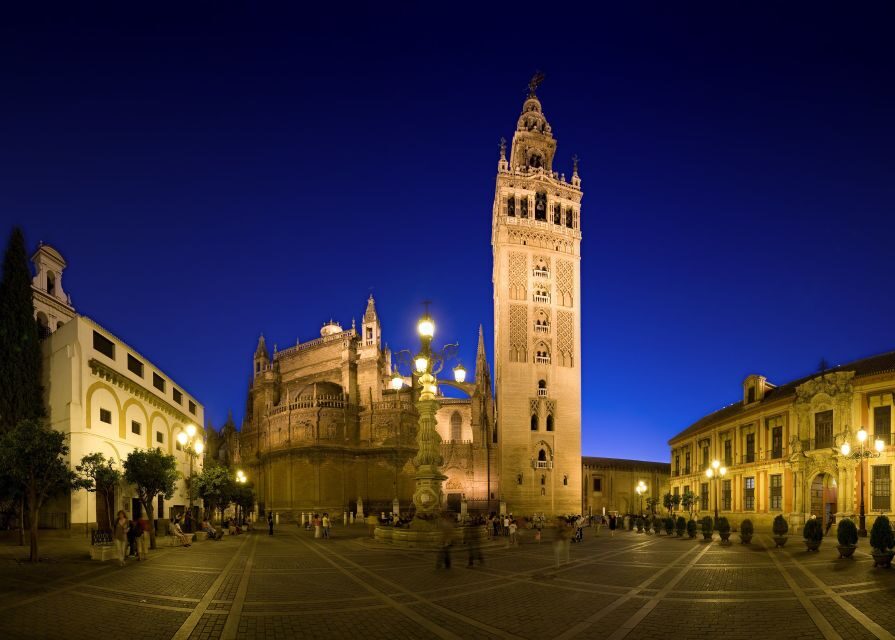
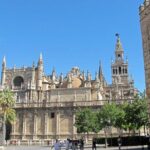
Your first major stop is Torre Giralda, the icon people picture when they think of Seville. Here’s what makes it special: it wasn’t just built as a church bell tower—it was originally the minaret of the original mosque. Construction began in 1184, and it reached 117.5 meters at the time, when it was the tallest building in Europe.
The Giralda is also memorable because it has no stairs. Instead, it uses ramps designed thick enough for riding horses during the call to prayer five times a day. That’s a detail worth remembering as you look up, because it explains why the whole structure feels engineered for movement and access rather than just climbing by foot.
What you’ll likely appreciate on a bike tour is the timing: you don’t just see it from one angle and move on. You get around 15 minutes here, enough to walk a bit for perspective while the city’s pulse keeps rolling around you.
Consideration: since admission is marked as not included for this stop, if you’re hoping to go inside or climb, you’ll need a separate ticket decision (or accept viewing from outside as your main plan).
Catedral de Sevilla: the mosque-to-cathedral story you can spot
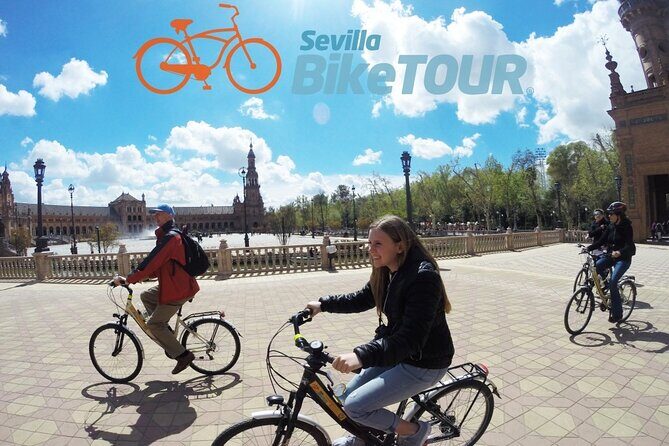
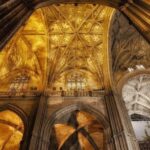
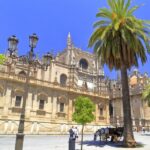
Next up is Catedral de Sevilla. The short stop window is perfect for getting the big idea: after Fernando III conquered Seville, legend says the plan was to build a cathedral so large that anyone who finished it would think they were crazy. The key part for your experience is that it was built on the original mosque site, with some original elements still preserved.
It’s also UNESCO World Heritage, so even if you’re not going inside, it’s worth seeing in person. A bike tour makes sense here because the Cathedral area is a dense knot of streets—walking alone can slow you down and drain your energy before the tour really hits its best stretch.
Admission here is also listed as not included, so think of this stop as an architectural “get the lay of the land” moment. You can still enjoy the scale and placement without paying for entry as part of the tour.
Real Alcázar de Sevilla: palace drama outside the screen
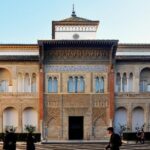
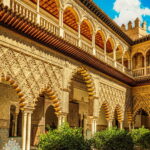
If you like history with pop-culture gravity, this is where your day gets easier to remember. Real Alcázar de Sevilla is described as a fortified palace and the official residence of the Royal Family when they’re in Seville. It was built during the Muslim period, and that shows in the exquisite chambers and gardens.
There’s also a reason it feels familiar to movie fans: it’s been used as a production setting for Game of Thrones and Lawrence of Arabia. You don’t need to be a superfan to enjoy that angle. It helps you look at the space with a “why does this place photograph so well” mindset.
This stop lists admission as free, and the time is about 15 minutes. I’d treat it as a high-impact pause: quick orientation, then a chance to soak in the transitions between palace textures and the surrounding garden feel.
If you want more than the quick stop, that’s where you’ll decide on your own. But even sticking to outside viewing, the Alcázar is one of the best “this place is bigger than you expect” sights in Seville.


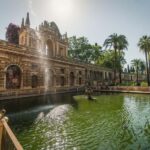
Plaza de España and Maria Luisa Garden: the 1929 wow factor
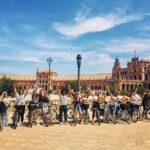
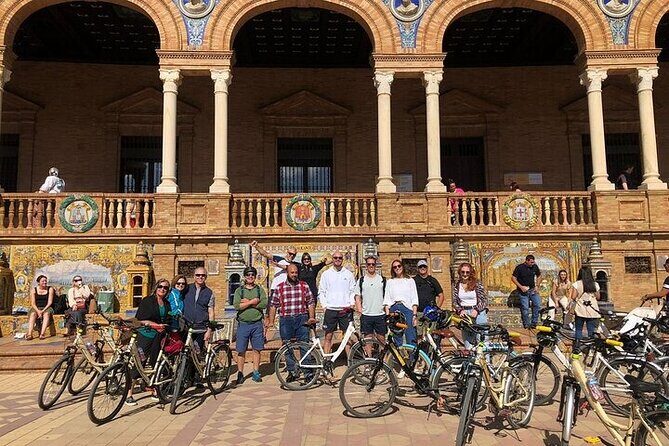
Then you roll into Plaza de España, built as the Spanish pavilion for the Iberoamerican exhibition of 1929. It’s considered a masterpiece of architect Ánibal González. If you’ve seen photos, you know the place looks designed for postcards. Up close, it becomes a giant stage with details spread all around—so many that you’ll want to slow down, even if only for a minute.
It’s set inside María Luisa Garden, and it includes references to Spain’s provinces and their styles. That means the plaza isn’t just a pretty set—it’s also a cultural catalog of sorts, shaped for an exhibition era.
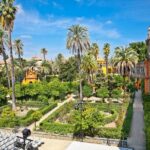
Just after that, you step into Parque de María Luisa, linked to the former San Telmo palace gardens. In 1893, María Luisa Fernanda de Orleans donated the gardens to the city. What that gives you as a visitor: a break from the hardest-working parts of historic Seville. The gardens and fountains help reset your senses.
Both Plaza de España and Parque de María Luisa list entry as free, with about 20 minutes at each stop. That free access plus the time makes this one of the best value blocks in the whole itinerary.
Practical thought: if you’re visiting during bright hours, aim to use these stops for shade and pace. Your bike tour gives you movement; the gardens help you recover.
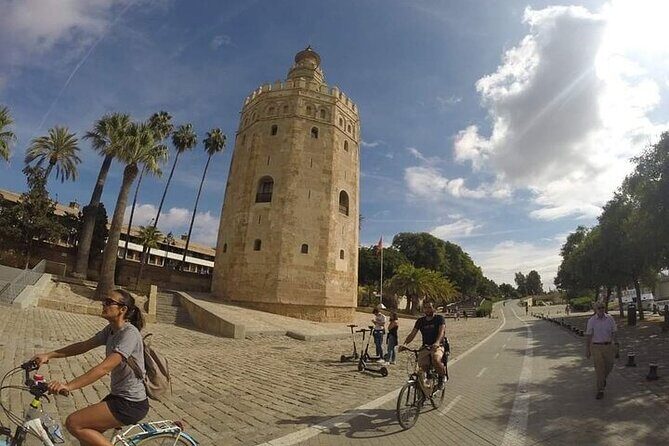
Torre del Oro: the river landmark with colonial ties
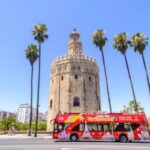
At Torre del Oro, you’ll see another Islamic-era structure connected to later Seville wealth. It was built during the Almohade reign in Sevilla and later used to store gold arriving from the colonies in the “Indias Occidentales” (South America).
This is one of those sights where the outside viewing still works because the tower’s role is about the river line. It’s like a visual bookmark—reminding you that Seville’s power was tied to navigation and trade.
Admission is marked as not included, and the stop is shorter (around 10 minutes). That means you should focus on the big picture: the tower’s placement and its relationship to the river, not trying to do everything.
Barrio Santa Cruz: patios, lanes, and an old Jewish quarter feel
Next you head into Barrio Santa Cruz, the maze-like neighborhood in the old center. It’s described as once being the Jewish quarter, and it’s famous for old houses, patios, and palaces, along with the city’s romance and mystery.
This stop is one of the best reasons to do a bike tour, because your bike gets you close while your feet can do the slower, more human exploration. Even with about 15 minutes, you can usually feel the neighborhood shift—streets tighten, shadows appear, and the pace changes.
Admission is listed as free, and the emphasis is clearly on walking through the character of the area rather than buying entry to a single site.
If you want one practical tip for this part: don’t try to memorize every turn. Instead, pick a lane or courtyard vibe you like, take a few minutes for photos, then keep moving so you stay on schedule.
Real Fábrica de Tabacos: when industry becomes a landmark
Then you reach Real Fábrica de Tabacos, a stone building from the 18th century. It was established as the first tobacco factory in Europe. Today, it houses the main building of the University of Seville.
That change—from tobacco industry to education—adds a layer to your understanding of Seville. You’re not just seeing “old stuff.” You’re seeing how a powerful building role continues in a new form.
This is a shorter stop (about 10 minutes) and entry is listed as free. Treat it as a quick architecture read: the building scale, the sheer solidity, and the fact that it still functions in the modern city.
Río Guadalquivir: the biggest river that still lets boats run
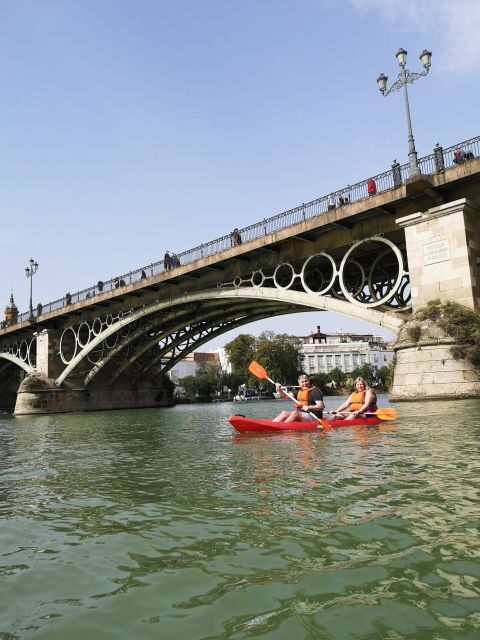
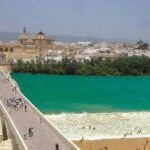
Your ride then connects to the Río Guadalquivir. In Roman times, the original name was Betis. It’s described as Andalucía’s biggest river and one of the few rivers in Spain that allows navigating.
This matters because Seville is a river city. If you only look at plazas and towers, you might miss what makes the city “work” historically: the connection between goods, people, and movement.
The river also originates in the Sierras de Cazorla y Segura Natural Park, which gives you a sense that this isn’t just a local water feature. It’s part of a larger geography. Stop time here is about 20 minutes, and entry is free.
Use this chunk to pause your bike time just enough to appreciate the riverfront scale. It helps the later neighborhood contrasts make more sense.
Triana across the water: flamenco, ceramics, and explorer lore
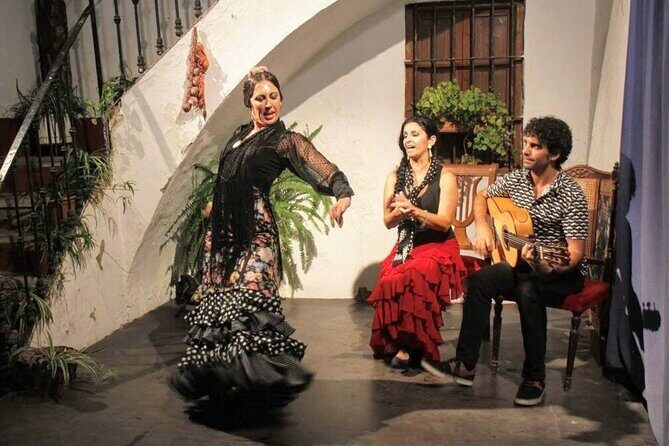
Next is Triana, on the other shore of the river. It’s described as the cultural heart of Spain, famous for flamenco music, mastery with ceramics, and literature. It’s also tied to exploration stories—named as the place where many original Spanish explorers and conquerors came from.
Triana is a great example of why Seville feels different in neighborhoods you might not expect. You get a clear shift from the main historic core to a place that feels more artistic and lived-in.
This stop is around 20 minutes, entry free. Since it’s near the river, it also tends to feel less like you’re stuck in a single monumental bubble. You’re watching daily life shape the street scene while the city’s big landmarks remain your backdrop.
Real Maestranza de Caballería: bullfighting arena and noble schooling roots
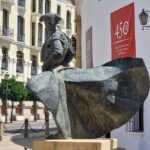
To wrap things up, you’re near Real Maestranza de Caballería de Sevilla, described as a major bullfighting arena and one of the most important in the world, with some saying it’s the most important.
The explanation that makes this stop more interesting is the origin story: it was created as a military and cavalry school for the nobility in the 17th century. That tells you something about how Seville’s elite culture evolved over time—showmanship wasn’t invented out of nowhere.
The stop is about 15 minutes, and admission is not included. This is a “see it and connect the dots” moment rather than a ticket-based experience.
If you’re a fan of Spanish cultural traditions, this stop helps you understand bullfighting as part of a longer institutional history, not just a modern event.
How fit and weather should shape your day
This tour is listed as doable for most travelers and allows service animals. It’s also described as requiring good weather. That’s not a small detail. Since this is a bike experience, rain or bad conditions can change everything—especially if your main goal is to see multiple landmarks quickly.
So if the forecast looks risky, keep your schedule flexible. The tour is planned as outdoors time blocks, and your enjoyment will depend on your ability to keep moving comfortably.
Is it worth $36.05? My take on value
For $36.05, you’re paying for structure and mobility: a bicycle, a water bottle, and a set route that hits multiple famous stops in about three hours. That’s good value if you want to see more than one district without spending your whole day commuting or walking.
But it’s not a “everything is included” ticket. Some major stops list admission as not included, so you’ll likely spend additional money if you want interiors. The best strategy is to decide your priorities early:
- If you want exterior viewing plus quick photo moments: you can get strong value from the full route.
- If you want to enter multiple monuments: you’ll want a ticket budget on top of the tour price.
The overall rating is 4.5 out of 5 from 17 ratings, and the standout theme is that the ride covers the big sights efficiently and leaves you feeling like you actually saw the city.
Should you book this Seville Bike Tour?
Book it if you:
- want a 3-hour way to cover Seville highlights without long planning
- like the idea of mixing monuments with neighborhood flavor, like Santa Cruz and Triana
- prefer an active sightseeing day where the bike does the legwork
Skip or reconsider if you:
- only care about full interior visits, since the tour is described as tour only from the outside
- hate the idea of adding extra monument tickets, since several stops aren’t included
If you’re visiting for the first time or you’re short on time, this is the kind of tour that helps you build a mental map fast—then you can come back later (on your own schedule) for any interiors you still want.
FAQ
How long is the Seville Bike Tour?
It runs for about 3 hours (approx.).
How much does the tour cost?
The price is $36.05 per person.
What language is the tour offered in?
The tour is offered in English.
Where does the tour start?
The meeting point is C. Arjona, 8, Casco Antiguo, 41001 Sevilla, Spain, and it ends back at the same spot.
Do I need tickets for the monuments?
Entry is not included for some stops (for example, the Giralda, Catedral de Sevilla, Torre del Oro, and Real Maestranza). Some stops are listed as free (including Real Alcázar, Plaza de España, Parque de María Luisa, Barrio Santa Cruz, Real Fábrica de Tabacos, Río Guadalquivir, and Triana).
What if weather is bad or I need to cancel?
The tour requires good weather. If it’s canceled due to poor weather, you’ll be offered a different date or a full refund. You can cancel for a full refund up to 24 hours in advance.