REVIEW · SEVILLE
Expert Tour of Seville in Private Eco Tuk Tuk
Book on Viator →Operated by Eco Tuk Tuk - Spain · Bookable on Viator
Seville looks different from the river to the rooftops. This private Eco Tuk Tuk tour is built for fast, comfy sightseeing, with set photo stops at major landmarks and viewpoints. It’s also a low-effort way to cover ground without draining your feet.
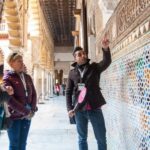
My favorite part is the people you’ll ride with. Guides like Karen, Juan, and Miguel come up in local feedback as friendly, upbeat, and eager to help you understand what you’re seeing. If you want an easy first look at Seville that still feels personal, this is the format that delivers.
One thing to think about: the route leans into big landmark areas, including Expo-era settings that can feel more architectural than deeply cultural. If you’re after very deep, museum-level time at every stop, you might find the pace a bit “highlights first,” since stops and photo moments are pre-planned.
In This Review
- Key points worth knowing before you go
- Getting Your Bearings in Seville by Eco Tuk Tuk
- The Triana Start: Bridge Views, Markets, and Calle Betis
- San Telmo Palace: Baroque Seville and Coastal-Education Roots
- Royal Tobacco Factory: Europe’s First Factory in Seville
- Plaza de España and the Maria Luisa Park Reset
- Plaza de América, Royal Pavilion, and the Torre del Oro
- Arenal and the Maestranza Bullring Stop
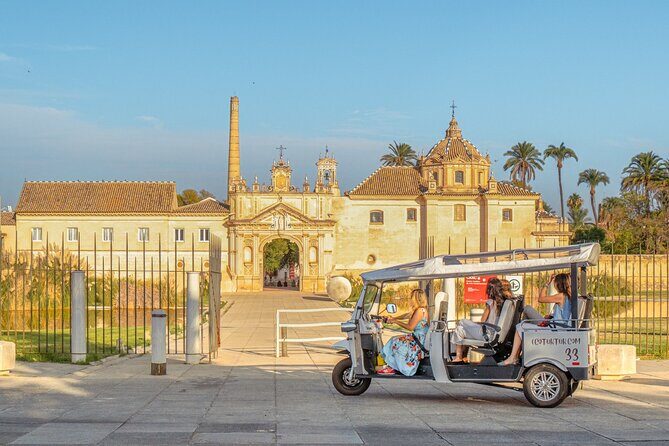
- Monasterio de la Cartuja: Carthusian Silence Meets Modern Seville
- Isla de la Cartuja and the 1992 Bioclimatic Sphere
- Basilica de la Macarena: A Neighborhood-Focused Finish
- Price and Time: Is This $80.23 Per Person Good Value?
- Who This Private Eco Tuk Tuk Tour Suits Best
- Booking Smart: What Can and Can’t Change
- Should You Book This Eco Tuk Tuk Tour of Seville?
- FAQ
- FAQ
- How long is the Eco Tuk Tuk tour in Seville?
- Where does the tour start and end?
- Is this a private tour or a shared group tour?
- What is included in the price?
- Are admission tickets included for the stops?
- What should I know about guide experience?
- Can I ride if I’m traveling with a baby or toddler?
- What happens if it rains?
- Can the route or photo stops be changed on request?
- Are pets allowed?
Key points worth knowing before you go
- Private ride, capped per tuk tuk: your group rides together, and each Eco Tuk Tuk has a legal max of 4 passengers.
- Pre-set photo stops: the best angles happen at specific places, and the route can’t be changed on the spot.
- Triana + river energy: you’ll get a taste of markets and tapas areas near the Isabel II (Triana) Bridge.
- Plaza de España time (and it’s free to enter): one of the main “Seville postcard” stops, with quick time to soak it in.
- Cartuja Island adds a modern twist: Monastery sights plus the bioclimatic sphere from the 1992 Universal Exposition.
- You get a smooth orientation: guides are consistently praised for helping you connect neighborhoods to the sights.
Getting Your Bearings in Seville by Eco Tuk Tuk
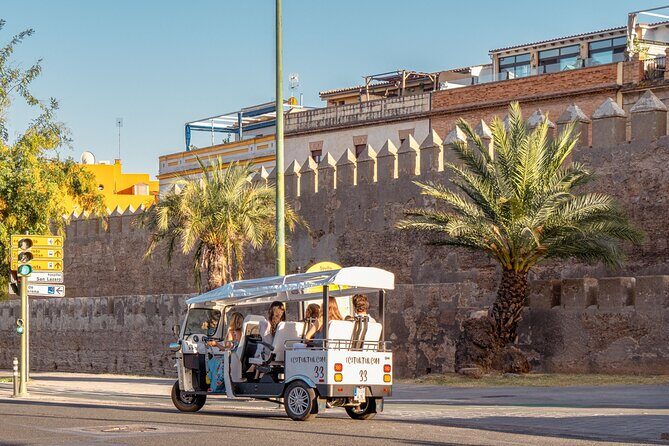
Seville is the kind of city where walking is great, but it can also eat time. This tour solves that by giving you a comfortable private ride that still feels fun, not rushed.
Your Eco Tuk Tuk route is designed around short stops where you can get out, take photos, and reset. The big upside is that you spend more time seeing the city and less time figuring out how to connect each area.
If you’re traveling with seniors or anyone who prefers less walking, the vehicles are described as suitable, and drivers will assist getting on if needed. In winter, the tuk-tuks use protective layers against rain and wind, plus blankets to keep things warm.
You can also read our reviews of more private tours in Seville

The Triana Start: Bridge Views, Markets, and Calle Betis
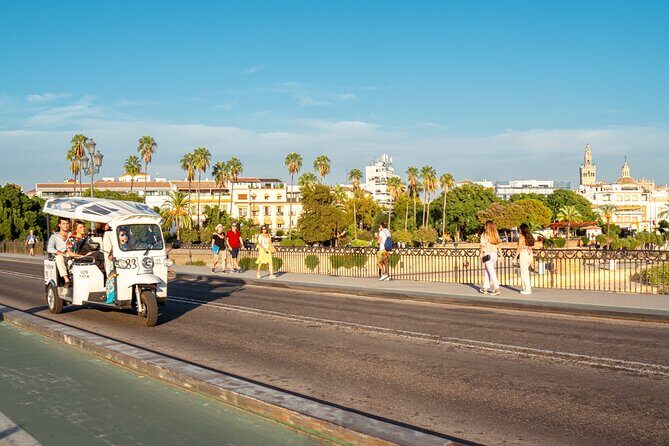
You begin near the Puente del Cristo de la Expiración area, then roll toward the Isabel II Bridge (the Triana Bridge). It’s the classic crossing over the Guadalquivir River that links the city center with Triana, and it’s an easy way to start seeing how Seville sits on its water.
Triana is where Seville gets more everyday. You’re looking at a neighborhood vibe tied to the market and the small food stalls nearby. Expect the kind of places that serve local favorites like salmorejo and croquettes, and you’ll also be close to Calle Betis along the river where you’ll find more bars and tablaos.
Even if you don’t plan to shop, Triana helps your trip feel real. Around the Centro Cerámica Triana area, you’ll run into shops connected to local craft, which makes the neighborhood more than a backdrop.
San Telmo Palace: Baroque Seville and Coastal-Education Roots
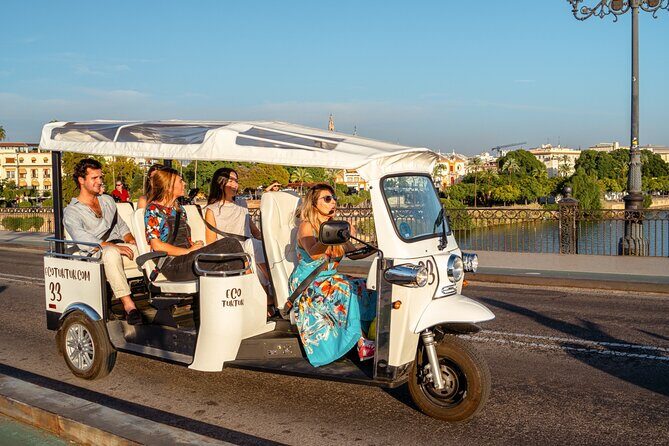
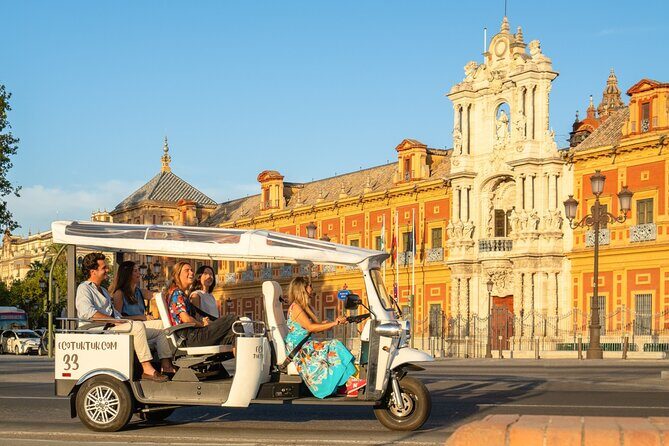
After Triana, the route includes the Palace of San Telmo. This Baroque building sits as the seat of the Presidency of the Junta de Andalucía, which means it’s not just a pretty shell—it’s still used in official life.
Built between the 17th and 18th centuries, the palace originally served as the headquarters of a sailors’ college. That detail matters because it gives you a clue about Seville’s long relationship with trade and the sea—even though today the city can feel more “old streets and plazas” than “port city.”
You get a quick stop here, so don’t expect a long linger like you would with a guided interior visit. But it’s a strong stop for perspective: it connects the city’s power, education, and architecture in one shot.
Royal Tobacco Factory: Europe’s First Factory in Seville
Next up is the Royal Tobacco Factory of Seville, a major industrial building from the 18th century. It was the headquarters of what’s described as the first tobacco factory established in Europe, and it remains one of Spain’s biggest industrial monuments from that era.
This is one of those sights where your guide’s framing can make it click. You’re not just looking at a big structure—you’re seeing how a city like Seville helped fuel global economic shifts through production, trade, and labor.
It’s also listed as a protected cultural monument since 1959 (classified as an Asset of Cultural Interest). That’s useful context because the building has weight, even when you’re only passing by for a short photo moment.
Plaza de España and the Maria Luisa Park Reset
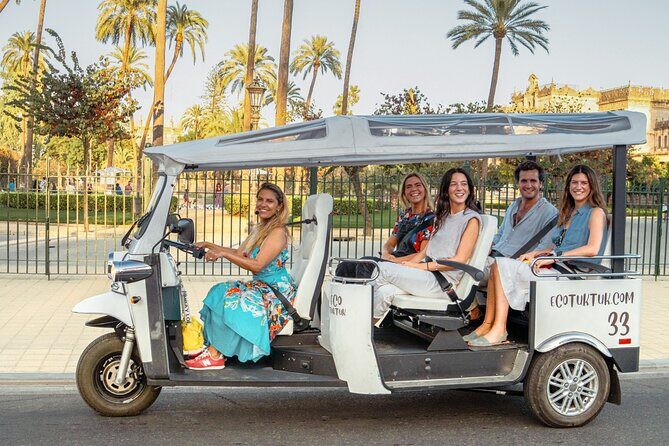
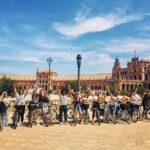
If Seville is a show, Plaza de España is one of the loudest scenes. The tour includes a stop here, and it’s marked as free in the info you’ll receive.
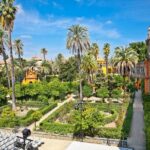
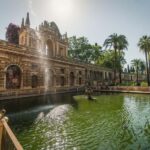
This plaza is tied to the María Luisa Park and was designed by Aníbal González, built between 1914 and 1929 for the Ibero-American Exposition of 1929. You’ll notice the “big-event” scale right away: it’s made to impress, with space that invites you to orbit it and find your own angles.
Then there’s the park itself. María Luisa Park is described as Seville’s first urban park and one of its green lungs. Declared a Historic Garden asset in 1983, it helps explain why Seville looks so layered: grand buildings are paired with outdoor breathing room.
On a practical level, this is the stop where the tour format shines. You get a short window to enjoy one of the most photographed places in Spain without committing your whole afternoon.


Plaza de América, Royal Pavilion, and the Torre del Oro
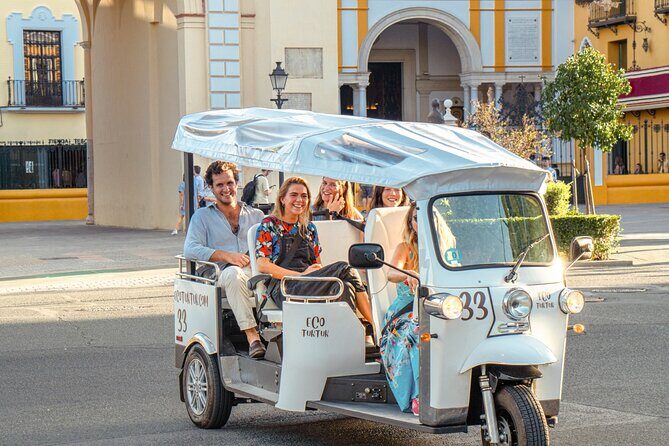
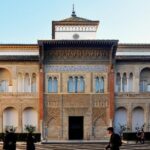
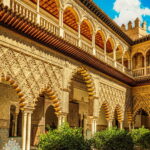
Inside Parque de María Luisa, the route mentions the Plaza de América, a landscaped space surrounded by nearby museums and key buildings like the Museum of Popular Arts and Customs, the Archaeological Museum, and the Royal Pavilion. Even if you don’t go inside, the surrounding layout gives you a sense of how planned this entire Expo area is.
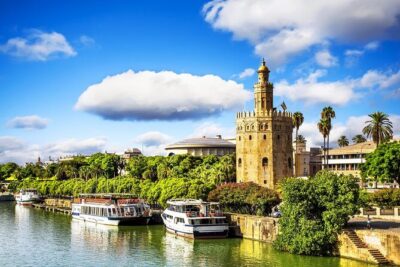
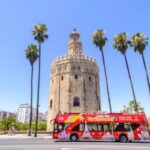
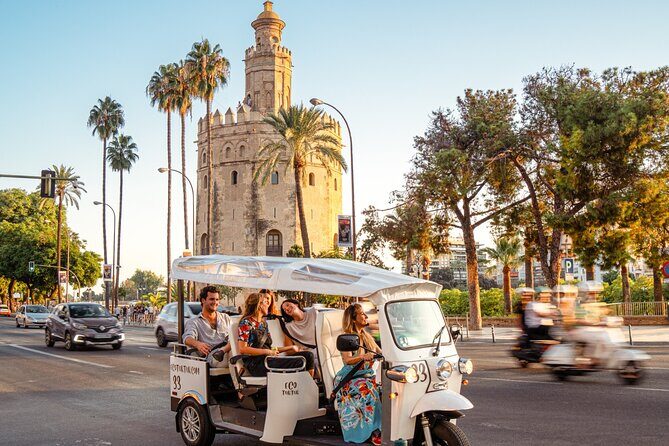
From there, you’ll hit the Torre del Oro, a watchtower on the Guadalquivir’s left bank. The tower dates to 1221, stands about 36 meters high, and is described as being made of three bodies.
This is the kind of stop that rewards you for looking closely at the tower’s structure, even if you’re just snapping photos. Torre del Oro works well on a tuk tuk because it’s designed to be seen from the street-level angles along the river.
Arenal and the Maestranza Bullring Stop
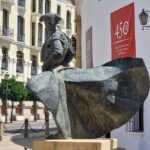
The tour also includes the Maestranza bullring, located in the Arenal neighborhood. It was built in the 18th century and is owned by the Real Maestranza de Caballería de Sevilla.
For some visitors, bullfighting is sensitive territory. If you’re not interested in that tradition, think of this as an architectural and civic landmark stop rather than a cultural deep dive. The value here is that you see Seville’s 1700s-era institutional side in the same sweep as parks and plazas.
This stop also helps balance the route. Without it, the day might feel too concentrated in Expo aesthetics and river viewpoints.
Monasterio de la Cartuja: Carthusian Silence Meets Modern Seville
When the route reaches Monasterio de la Cartuja (Santa María de las Cuevas), you’re heading to the island of La Cartuja. The Cartuja Monastery is a Carthusian monastery, and the info describes it as one of four Carthusian monasteries in Andalusia.
Even with a short stop, the monastery setting changes the mood. You’re leaving the city’s showpiece plazas behind and stepping into a space associated with monastic rhythm—simple, structured, and built to last.
The tour info marks admission as not included for this stop, so if you plan to go in, plan on handling entry separately. This is worth knowing because it affects how much time you can spend there on a highlight-style tour.
Isla de la Cartuja and the 1992 Bioclimatic Sphere
After the monastery stop, you continue to Isla de la Cartuja, a cultural and avant-garde space for leisure, entertainment, and art. This is where Seville shows you it isn’t only old churches and river views—there’s a modern layer tied to big exhibitions.
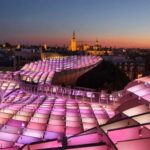
One of the standout icons is the bioclimatic sphere on Marie Curie Street. It’s described as one of the most recognizable symbols from the Universal Exposition of Seville in 1992.
This is a great stop for photos because the structure is unusual and instantly recognizable. It’s also a practical reminder: the tour’s “highlights” style can mean you’ll spend part of your time in repurposed Expo zones.
That doesn’t make it bad. It just helps you calibrate expectations. If you want pure Andalusian old-world immersion, you may wish you had extra time in older quarters. If you want variety in one ride, Cartuja delivers.
Basilica de la Macarena: A Neighborhood-Focused Finish
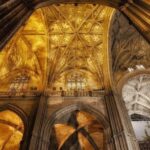
The tour wraps with a stop at the Basilica de la Macarena. It’s a Catholic temple located at Calle Bécquer 1 in the San Gil neighborhood of the Casco Antiguo district.
This stop can feel like a different tone from the Expo areas. Instead of staged grandeur, you get something more grounded in everyday Seville’s religious life and neighborhood identity.
As with several other stops, admission isn’t listed as included, so it’s best to treat the visit as a quick exterior and photo moment unless you arrange entry during your time there.
Price and Time: Is This $80.23 Per Person Good Value?
At $80.23 per person, this tour sits in the “not cheap, but not outrageous” range for a private experience. The value equation here is simple: you’re paying for transport + guide + photo-stop efficiency.
The duration matters. The experience is listed as about 1 to 2 hours, and the longer (120-minute) version includes an extra stop at Isla de la Cartuja in addition to Plaza de España. If you can, the 120-minute timing often makes more sense because it adds the modern island contrast, not just the postcard classics.
It’s also private, but the tuk-tuks are booked based on the number of vehicles you need for your group. The legal max is 4 passengers per tuk tuk, so if you have a larger group you may use more than one vehicle, which can change your per-person math.
My practical advice: this tour is best when you want a guided orientation and a stress-free scan of Seville’s top sights. If you already know the city well or plan to do long, paid museum visits, you may get less value from the short stop style.
Who This Private Eco Tuk Tuk Tour Suits Best
This tour fits best if you want less walking and more city coverage. It’s ideal for people who’d rather spend their limited time in Seville seeing several neighborhoods than staying locked into one.
It’s also a good match for families. The tour allows participants aged two and up, and it says babies are not allowed, so if you’re traveling with little ones, you’ll want to double-check fit.
If you care about photos, this format is built for that. The route is designed for pre-established photo moments, with guides who know the best ways to frame the big sights without wasting time.
And if you’re the kind of traveler who likes a first-day plan, a highlight tour like this can be a smart foundation. Later, you can return on your own to the places that hooked you.
Booking Smart: What Can and Can’t Change
One thing to keep your expectations straight: the tour route and photo stops are pre-established, and you can’t modify them on the day. Street closures or demonstrations can shift the exact path, but you’ll still follow the plan designed for your selected duration.
Another practical note is timing discipline. If someone in your group is delayed, the activity can be reduced based on time lost, and if the delay is more than 15 minutes, the tour can be canceled without a refund. So set yourself up for success and show up a little early.
Should You Book This Eco Tuk Tuk Tour of Seville?
Book it if you want a private, low-effort introduction to Seville that still includes signature landmarks like Plaza de España, plus a river-to-island contrast with Triana and Cartuja. If your priority is seeing a lot with minimal stress, this is a strong fit.
Skip it or consider a different format if your top goal is deep cultural time in fewer places. The route can lean toward Expo-era and repurposed architecture, and the stop style is short by design.
If you do book, pick the 120-minute option when you can. You get more variety, including the Cartuja island segment and the bioclimatic sphere, which is the kind of memorable visual you can’t easily recreate later without planning.
FAQ
FAQ
How long is the Eco Tuk Tuk tour in Seville?
The experience runs about 1 to 2 hours, depending on the tour option you select.
Where does the tour start and end?
It starts at Parking APK2 ArjonaPuente del Cristo de la Expiración, 746, Casco Antiguo, 41001 Sevilla, Spain and ends back at the same meeting point.
Is this a private tour or a shared group tour?
It’s private, and only your group participates.
What is included in the price?
An accompanying guide is included.
Are admission tickets included for the stops?
Not always. Plaza de España is listed as free, while several other stops are marked as admission ticket not included.
What should I know about guide experience?
The tour relies on an accompanying guide, and people highlight specific guides by name, including Karen, Juan, and Miguel, for being friendly and helpful.
Can I ride if I’m traveling with a baby or toddler?
Minimum age is two years. Babies are not allowed.
What happens if it rains?
The tuk-tuks have protective layers against rain and wind in winter, and they include blankets to keep warm.
Can the route or photo stops be changed on request?
No. The itinerary and photo stops are pre-established and can’t be modified during the tour.
Are pets allowed?
No, pets and companion animals are not allowed for security reasons.