REVIEW · SEVILLE
Private tour of Seville highlights
Book on Viator →Operated by Beatriz Pérez García · Bookable on Viator
Two hours, ten Seville icons, zero tickets. This private highlights route strings together the city’s headline sights with a guide who helps you connect the dots, from Plaza del Triunfo to Plaza de España. It’s a practical way to get your bearings fast, without getting stuck in long lines.
I especially like the small private group setup (up to 15), which makes it easier to ask questions and keep moving at a good pace. I also like how the walking route spotlights big-name landmarks from the outside, with clear explanations of what you’re looking at—people like guides such as Beatriz Pérez García (and others credited on similar tours, like Juan) bring that local energy.
One possible drawback: this is an exterior route, so it does not include entrances to monuments. If you want to go inside places like the Catedral or the Alcázar, plan on buying those tickets separately.
In This Review
- Key Things to Know Before You Go
- Plaza del Triunfo to Plaza de España: The Smart, Quick Route
- Private Guide Value: Small Group Energy That Makes It Click
- Stop-by-Stop Highlights (and What to Look For)
- Plaza del Triunfo: Where Seville’s Biggest Names Gather
- Archivo General de Indias: 9 Kilometers of Stories in Shelves
- Catedral de Sevilla and the Giralda: Mosque Roots, Christian Symbols
- Real Alcázar de Sevilla: A Muslim-Origin Palace Still Linked to Power
- Plaza del Cabildo: Geranium Balconies and the Sunday Market Feel
- Walking the Guadalquivir: Betis Street Reflections and Triana Behind It
- The Government Palace, a Legendary Hotel, and a Tobacco Factory Story
- Palacio de San Telmo: Baroque Stone and the Sailor’s Saint
- Hotel Alfonso XIII: A Luxury Landmark with a 1929 Role
- Real Fábrica de Tabacos: New-World Tobacco and the Carmen Connection
- Plaza de España: The Final Big Scene (and Why It Gets Extra Minutes)
- Price and Logistics: Is $85.19 Worth It?
- Who This Seville Tour Fits Best
- Should You Book This Private Seville Highlights Tour?
- FAQ
- FAQ
- How long is the private Seville highlights tour?
- What’s the price per person?
- Is this tour private or shared?
- Does the price include entrance tickets to monuments?
- Are audio guides included?
- Is pickup available?
- Where does the tour start and end?
- What language is the tour offered in?
- What group size is allowed with the private guide?
- Are service animals allowed, and is public transport nearby?
- What is the cancellation policy?
Key Things to Know Before You Go
- Small private group (up to 15 people) means less crowding and more conversation
- Exterior-only route keeps it fast, but monument entry tickets are not included
- Pickup offered: your guide waits in the hotel lobby
- Covers major landmarks in about 2 hours: short stops, strong orientation
- English is available, plus a note about audio guides for larger groups
- Plaza de España gets extra time for photos and a slow stroll
Plaza del Triunfo to Plaza de España: The Smart, Quick Route
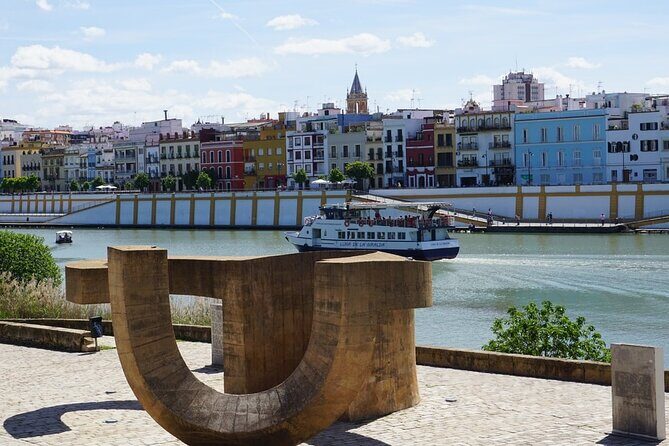
This tour is built for people who want Seville to make sense quickly. Instead of scattering you across the city, it keeps everything clustered in a walkable sweep—from the historic core near the Cathedral to the grand setting of Plaza de España.
The timing is short at each stop (often about five minutes, with Plaza de España lasting closer to ten). That means you won’t stand around too long, even if you stop for photos. It’s a “see it, understand it, move on” format, which is a good match for first-timers and for anyone short on time.
And yes, the “no entrances” part matters. You’ll get exterior views, key architectural clues, and stories behind what you see. If you want the full inside experience of Seville’s museums and churches, this works best as a first step before you add entrance tickets on another day.
You can also read our reviews of more private tours in Seville



Private Guide Value: Small Group Energy That Makes It Click
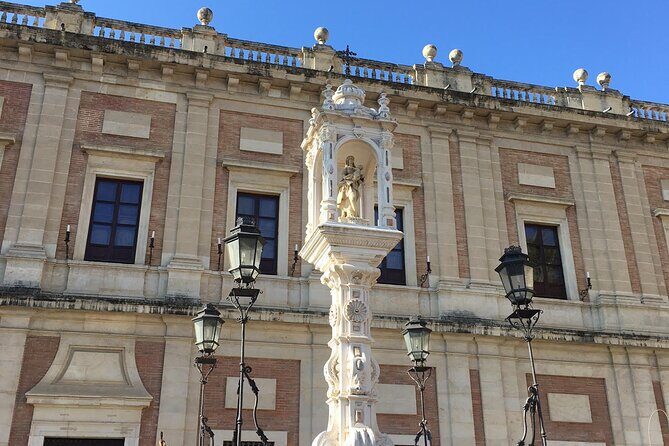
You’re paying for a private guide rather than a big bus-style narration. With a group that doesn’t exceed 15, the guide can slow down for the questions you actually care about.
The standout from the experience details is that the guides are praised for both knowledge and passion for the city. That shows in the way the tour moves: it’s not just “this is that building,” it’s “here’s why it matters and what to watch for.” It’s the difference between seeing a tower and understanding why its top is a standout symbol.
If you’re the type who likes travel with context—religion, power, trade, and art—this tour format suits you. It also helps if you’re traveling with others who need a bit more structure to enjoy the walking day.
Stop-by-Stop Highlights (and What to Look For)
Plaza del Triunfo: Where Seville’s Biggest Names Gather
You start in Plaza del Triunfo, a square that’s basically a viewfinder for the city’s main monuments. From here, you can admire major landmarks like the Alcázar, the Cathedral, and the Archive of the Indies.
There’s also a local cultural note baked into the place. On December 8, the tunos from different university faculties sing to the Immaculate Virgin near the area. Even if you’re not there in December, it’s a good reminder that Seville isn’t only stone and history—it keeps living traditions.
This stop is a great warm-up because you’re not yet committing to the specifics of one monument. Instead, you get a broad sense of what sits where, so later stops feel less random.
Archivo General de Indias: 9 Kilometers of Stories in Shelves
Next comes the Archivo General de Indias—a building tied to the documentation of the New World conquests. The tour framing is clear: this is where the paperwork and material used for exploration and conquest lived, including cartographic maps and navigation charts.
The big detail to remember is the storage scale: information organized in 9 kilometers of shelves. That gives you a sense of how much was recorded, collected, and managed—more than most people can imagine when they picture “history” as a handful of dates.
One practical note: admission is not included here on this route. But even from outside, the building’s role makes it worth the stop because it shifts your perspective. You stop thinking only about emperors and battle scenes, and start thinking about logistics, navigation, and records.


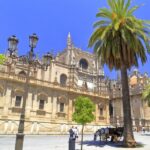
Catedral de Sevilla and the Giralda: Mosque Roots, Christian Symbols
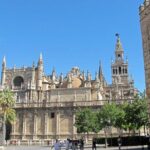
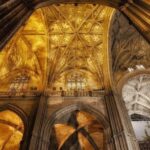
Then you get the Catedral de Sevilla and the iconic Giralda tower. The key framing: this Catedral was built on an older mosque. That single fact changes how you look at the architecture—you start noticing layers rather than one straight line of style.
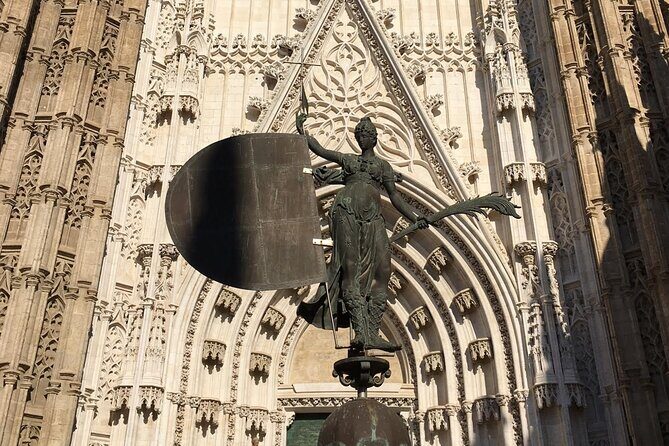
The Giralda is the star. At the top is a weather vane with the figure of a pregnant woman, explained here as representing the state of good hope. It’s the kind of symbol that would be easy to miss if you were just snapping photos without a guide.
You also look toward the Puerta del Perdón, described as a door given a Christian aspect. The statues flanking the entrance matter: Saint Peter is shown with keys, and Saint Paul with a sword.
If you’re a fan of symbolism, you’ll enjoy this stop. If you need more time for photos and close detail, you might feel a little rushed—because this tour keeps moving and doesn’t include entrance tickets.
Real Alcázar de Sevilla: A Muslim-Origin Palace Still Linked to Power
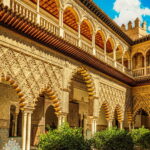
From the Cathedral zone, you shift to the Real Alcázar de Sevilla viewpoint. The tour explanation gives the essentials: the palace was built in the 10th century by Muslims, and today it’s where Spanish kings stay when they come to Seville.
Even without entering, that “then and now” link is a strong way to understand what you’re seeing. It’s not only a monument; it’s an active symbol of state presence.
Keep your eyes open for how the palace connects with the surrounding historic streets. The Alcázar is one of those places where your impressions improve if you’re mentally tracking time periods, so the guide’s context helps.
Again, entry is not included here on the exterior route, so treat this as a view-and-story stop unless you plan follow-up tickets.
Plaza del Cabildo: Geranium Balconies and the Sunday Market Feel
Next is Plaza del Cabildo, a picturesque square directly in front of the Cathedral area. The tour calls out balconies with geraniums, which gives the scene a lived-in, everyday beauty.
There’s also a weekly rhythm: on Sundays, there’s a market for antiques, coins, and stamps. Even if you’re not there on Sunday, it’s a neat detail because it tells you the square isn’t just for tourists—it has routines.
This stop works well for a quick breather. You can step away from the main monuments and get a sense of what it feels like when the area is used by people, not only admired by visitors.
Walking the Guadalquivir: Betis Street Reflections and Triana Behind It
Now you move along the Guadalquivir River, where the tour turns your attention toward views. The focus is on the famous Betis Street, known for colorful houses whose colors reflect in the water.
Then you look toward Triana in the background, explained here as the birthplace of flamenco. It’s a simple line, but it helps you “place” Triana geographically in your mind, so later you can connect the idea of music culture with the districts around it.
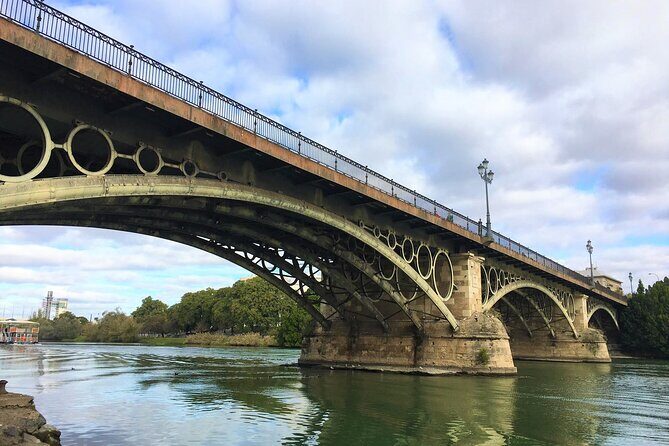
You also spot the Isabel II Bridge, built on an old boat bridge. That kind of detail makes the river feel more functional and less like a postcard background.
No entrance tickets here, just a guided walk with a story on each side of the path. This is one of the calmer sections of the day.
The Government Palace, a Legendary Hotel, and a Tobacco Factory Story
After the river scene, the tour shifts into a sequence of dramatic buildings and institutions. This is where Seville’s layers show up most: religion, administration, luxury, and trade all in one compact route.
Palacio de San Telmo: Baroque Stone and the Sailor’s Saint
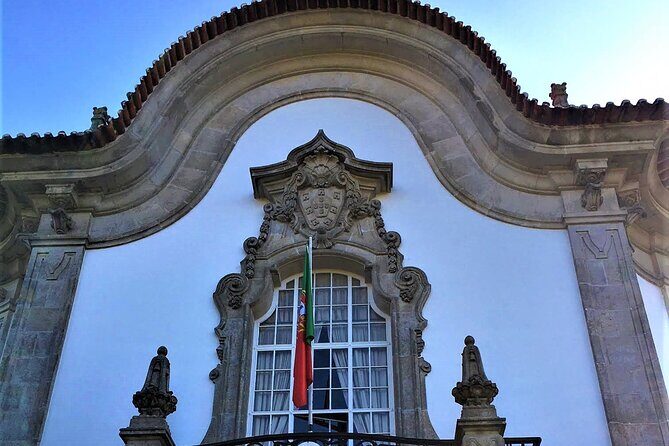
You stop at the Palacio de San Telmo, described as massive in size and currently the headquarters of the government of Andalusia.
The façade is called baroque stone, and the guide points out San Telmo, the patron saint of sailors, shown with a small boat. That’s the kind of imagery that helps you read architecture like a language—who is celebrated, and why.
Admission is not included, so the value is in what you learn to notice from outside.
Hotel Alfonso XIII: A Luxury Landmark with a 1929 Role
Next is Hotel Alfonso XIII, a Luxury Collection Hotel. The tour notes it was used during the 1929 exhibition, giving the visiting personalities a place to stay.
That detail matters because it connects Seville’s grandeur to a specific moment in modern history. It’s easy to treat a luxury hotel as just a backdrop, but in this context it becomes part of the city’s exhibition era story.
If you like travel that connects architecture to dates, this stop will land well.
Real Fábrica de Tabacos: New-World Tobacco and the Carmen Connection
Then comes the Real Fábrica de Tabacos, a key trade building where tobacco from the New World arrived and was manufactured in bales. The tour also connects it to smoking consumption later on.
There’s a cultural link here too: it’s described as the setting for Carmen, called the first feminist opera in history in the way this tour presents it.
That may be more interpretation than strict fact for every reader, but the takeaway is clear: the building isn’t only about commerce. It also influenced art and storytelling. Even without entering, it’s a strong stop for anyone interested in how trade and culture overlap.
Again, this is an exterior viewing stop on this route, so plan extra time and tickets if you want interiors.
Plaza de España: The Final Big Scene (and Why It Gets Extra Minutes)
You end at Plaza de España, in María Luisa Park, which is described as the city’s most magical place. Your guide frames why the layout feels so theatrical: a lake wraps around the square, and there are four bridges symbolizing ancient kingdoms from the times of the Catholic Monarchs.
The tour also highlights the 48 benches, representing Spain’s 48 provinces. If you’ve ever felt lost in big monuments, this detail helps. It gives you a way to scan the space logically instead of only staring upward.
And yes, there’s family-friendly fun: the square is also designed for little boat strolls around the lake. Even if you don’t plan to rent anything, it’s a nice reminder that this place works as public space, not just a photo set.
This stop gets more time than the rest, and you’ll feel that in the best way. It’s the kind of place where photos take a few extra minutes and your feet want a slower pace.
Price and Logistics: Is $85.19 Worth It?
This tour runs about 2 hours and costs $85.19 per person. It’s private, English-speaking, and includes a private guide for groups up to 15. You also get a mobile ticket, and confirmation is provided at booking time.
For the price, you’re really buying orientation plus a guide who tells you what to notice. Because entrances are not included, the tour stays efficient. You’re less likely to lose half the day in ticket lines and more likely to get a coherent first-impression of Seville.
Here’s when the value is strongest:
- You have a tight schedule and want the big highlights in one go
- You prefer guided context over wandering
- You’ll likely return later to buy monument tickets for the places you care about most
Here’s the trade-off:
- If your main goal is interior visits, this won’t satisfy that on its own
- Short stop times mean you can’t linger unless your guide builds in extra moments
One more logistics note: pickup is offered, and your guide waits for you in the hotel lobby. The tour ends at Plaza de España, so you’ll want to plan your next step from that side of town.
Who This Seville Tour Fits Best
This is a smart choice if you’re:
- Visiting Seville for the first time and want a clean path through the classic sights
- Traveling in a private group that values explanation, not just landmarks
- Trying to balance walking with downtime and short stops
- Interested in how Seville connects religion, administration, and trade
It may not be ideal if you hate walking. Even though each stop is brief, you still move between several major areas. It also may not be ideal if you specifically want to enter many monuments during the same session, since the route is exterior-only.
If you do want entrances, I’d treat this tour as the day you decide what to return to. After you see the symbols and layouts explained, buying the tickets for the interior visits feels more targeted.
Should You Book This Private Seville Highlights Tour?
Book it if you want a guided, efficient route through Seville’s most recognizable sights—plus the stories that make those sights feel real. The small private group and guide-led explanations are a strong combo for first-time navigation.
Skip it only if your dream day is built around entering specific monuments back-to-back. Since this route is outside-focused, you’ll still need separate tickets if you want the full interior experience of places like the Catedral or the Alcázar.
FAQ
FAQ
How long is the private Seville highlights tour?
It’s listed at about 2 hours.
What’s the price per person?
The price is $85.19 per person.
Is this tour private or shared?
This is a private tour/activity, so only your group participates.
Does the price include entrance tickets to monuments?
No. It’s an exterior route and it does not include entrance to monuments.
Are audio guides included?
Audio guides are mentioned as mandatory for groups of more than 7 people, at 1 euro per person. The base tour description also mentions audio guides as an option.
Is pickup available?
Yes. Pickup is offered, and the guide waits for you in the hotel lobby.
Where does the tour start and end?
It starts at Plaza del Triunfo and ends at Plaza de España (a semicircular square surrounded by a lake).
What language is the tour offered in?
The tour is offered in English.
What group size is allowed with the private guide?
The private guide visit is not exceeding 15 people.
Are service animals allowed, and is public transport nearby?
Service animals are allowed, and it’s near public transportation.
What is the cancellation policy?
The experience is non-refundable and cannot be changed for any reason.
If you want, tell me your travel dates and whether you plan to buy monument tickets separately. I can suggest a simple pairing plan so you don’t end up doing the same sights twice.